

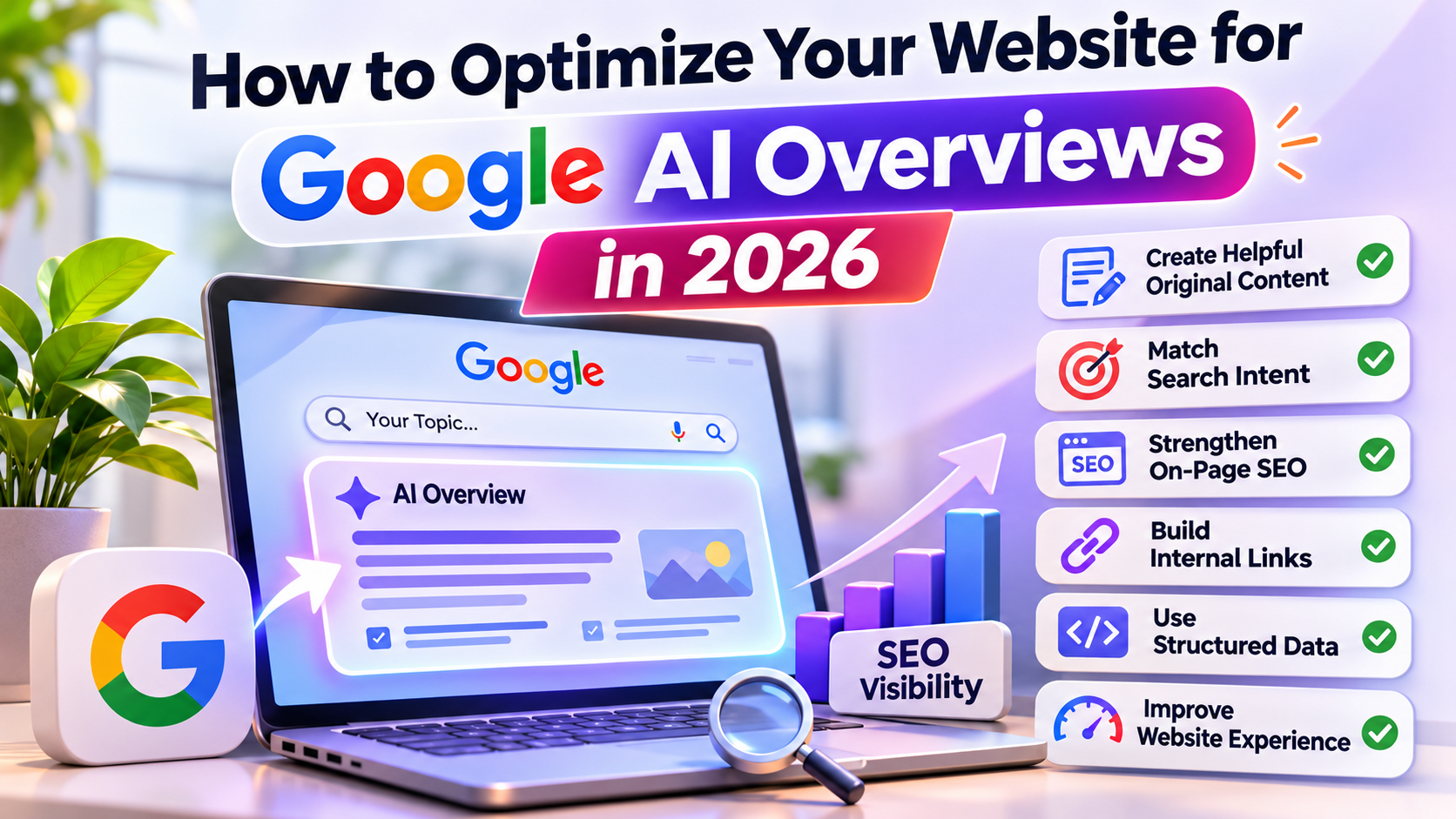
How to Optimize Your Website for Google AI Overviews in 2026
Google Search is changing rapidly, and Google AI Overviews are becoming an important part of how users discover information online. Instead of showing only traditional blue links, Google can now provide an AI-generated summary with links to relevant websites.
For businesses, bloggers, and e-commerce websites, this creates a new SEO opportunity. The goal is no longer just to rank at position one. Your website should provide useful, trustworthy and well-structured information that Google can understand and potentially use when generating AI-powered search results.
What Are Google AI Overviews?
Google AI Overviews are AI-generated summaries that appear at the top of Google Search for certain queries. They help users understand complicated topics without opening multiple search results.
However, AI Overviews are not completely separate from traditional SEO. Google says its generative AI search features continue to rely on web ranking systems and relevant web content. Google is also increasing the number and visibility of links within AI experiences, giving websites opportunities to receive qualified traffic. blog.google
That means your SEO foundation still matters.
1. Create Original, Helpful Content
The first step to optimizing for Google AI Overviews is creating content that provides something genuinely useful.
Avoid rewriting the same information already available on hundreds of websites. Instead, add:
- Original examples
- Practical steps
- First-hand insights
- Comparisons
- Data and statistics
- Expert explanations
- Clear answers to specific questions
Google’s updated guidance specifically emphasizes unique, non-commodity content for visibility in generative AI search experiences. blog.google
For example, instead of writing another generic article about “digital marketing,” explain how a small Indian business can build a realistic digital marketing strategy with a limited budget.
2. Answer Search Intent Clearly
One major mistake businesses make is writing for keywords instead of people.
If someone searches “how to optimize a website for Google AI Overviews,” they probably want practical steps rather than a 2,000-word introduction explaining what Google is.
Structure your content around real questions:
- What are Google AI Overviews?
- How does AI search understand websites?
- How can businesses improve visibility?
- What type of content works best?
- Does traditional SEO still matter?
Clear question-and-answer sections make your content easier for both users and search systems to understand.
3. Strengthen Your On-Page SEO
Traditional SEO has not suddenly become useless because AI arrived. Humans invented a new machine and immediately decided the old machine was dead. Search engines, apparently, did not receive the memo.
Your website should still have:
- Descriptive page titles
- One clear H1
- Logical H2 and H3 headings
- Optimized URLs
- Relevant internal links
- Descriptive image alt text
- Fast-loading pages
- Mobile-friendly design
- Properly structured content
Google’s own documentation states that SEO best practices remain relevant for success in generative AI features. Google for Developers
4. Build Strong Internal Linking
Internal links help Google discover related pages and understand the relationship between topics on your website.
For example, if you publish an article about Google AI Overviews, you can link to related pages about:
- SEO services
- Content marketing
- Website development
- E-commerce SEO
For businesses working on their digital presence, DigiBrandUp can also build a connected content structure around services and informational articles, rather than treating every page like an isolated island.
5. Improve Website Experience
Content alone is not enough.
Your website should be easy to navigate, mobile-friendly and technically accessible. Pages should load quickly and provide a smooth experience.
Google’s 2026 guidance also highlights page experience, along with useful images and video, as areas website owners should consider when preparing for generative AI search. blog.google
Technical SEO should therefore remain part of your strategy.
6. Use Structured Data Where Relevant
Structured data can help search engines understand important information on your pages.
Depending on your website, this may include relevant schema for:
- Articles
- Products
- Organizations
- Local businesses
- Breadcrumbs
- Events
But don’t add schema simply because you heard that “more schema equals more rankings.” That’s SEO folklore wearing a tie.
Use structured data that accurately represents visible content on the page.
7. Build Trust and Authority
Google AI Overviews need reliable information. Your website should clearly demonstrate why users should trust your content.
Add appropriate author information, company details, contact information, references and credible external sources where useful.
For factual or technical topics, link to authoritative resources. Google’s AI search experiences are increasingly designed to help users explore original sources and websites directly. blog.google
8. Monitor Your Search Performance
SEO is not a “publish once and pray” strategy.
Use Google Search Console to monitor impressions, clicks, queries and page performance. Google has also introduced additional insights and controls for websites appearing in its generative AI search features. blog.google
Look for pages receiving impressions but low clicks. These pages may need better titles, stronger introductions, clearer answers or improved search intent alignment.
FAQs
1. Can any website appear in Google AI Overviews?
No. There is no guaranteed method to make a page appear in an AI Overview. Focus on high-quality, useful content and strong technical SEO.
2. Does traditional SEO still matter in 2026?
Yes. Google continues to emphasize SEO fundamentals alongside optimization for generative AI search experiences. Google for Developers
3. Should I use AI to write SEO content?
AI can assist with research, outlines and editing, but publishing large amounts of generic content is a weak strategy. Add original information, expertise and genuine value.
4. How can I improve my chances of appearing in AI Overviews?
Create authoritative content that directly answers user questions, improve technical SEO, strengthen internal linking, use relevant structured data and build trustworthy topical coverage.
Conclusion
Optimizing for Google AI Overviews in 2026 is not about discovering a secret AI ranking trick. It is about making your website genuinely useful, technically strong and easy for search systems to understand.
Traditional SEO, original content, search intent, internal linking, structured data and website experience still form the foundation. Businesses that combine these fundamentals with genuinely valuable information will be in a much stronger position as Google Search continues evolving.
For businesses looking to improve their online visibility, DigiBrandUp can help create a stronger combination of SEO, website development, e-commerce and digital marketing strategies rather than relying on keyword stuffing alone.