AI Search vs Traditional SEO: What Will Change in 2026?
For years, SEO had a fairly simple goal: get your website to appear higher in Google Search and bring more visitors to your pages.
Businesses researched keywords, optimized titles, built backlinks, improved page speed, published blogs, and tried to reach the first page of Google. That basic approach still matters, but search behavior is changing.
In 2026, people are increasingly using AI-powered search experiences to ask longer, more conversational questions. Instead of opening several websites and comparing information themselves, users can receive a summarized answer and decide what to do next.
That creates an important question for marketers and business owners:
Is traditional SEO still enough in 2026, or does your business need to optimize for AI search too?
The answer is not to throw traditional SEO away. The smarter approach is to build on it.
For businesses such as DigiBrandUp, this shift creates an opportunity to combine technical SEO, useful content, brand authority, and AI search visibility into one broader search strategy.
What Is Traditional SEO?
Traditional SEO, or Search Engine Optimization, is the process of improving a website so search engines can understand its content and users can discover it through organic search.
A traditional SEO strategy usually includes:
- Keyword research
- On-page SEO
- Technical SEO
- Internal linking
- Content creation
- Backlink building
- Mobile optimization
- Website performance
- Search intent optimization
- Conversion optimization
For example, an ecommerce company may target a keyword such as “ecommerce website development company in India.”
The business creates a useful service page, optimizes the content, improves the technical structure, builds authority, and tries to earn visibility in search results.
Google’s own SEO documentation explains that SEO helps search engines understand content and helps users find websites through search. It also emphasizes useful, well-organized and people-first content.
That foundation is still important.
The difference is that search is no longer limited to a traditional list of blue links.
What Is AI Search?
AI search uses artificial intelligence to understand questions, context and relationships between information and then provide more conversational responses.
Instead of typing:
“best digital marketing agency India”
a user might ask:
“I run a small ecommerce business in India. What digital marketing strategy should I use if I have a limited budget?”
That second question contains much more context.
An AI-powered search experience can potentially interpret the user’s goal and provide a more detailed answer.
This changes the way businesses think about visibility.
In traditional search, the primary objective might be:
Rank → Get Click → Generate Traffic
With AI search, the journey can look more like:
Get Understood → Become a Trusted Source → Appear in Answers → Build Brand Awareness → Generate Demand
That does not mean clicks have become irrelevant.
It means clicks are no longer the only thing marketers should watch.
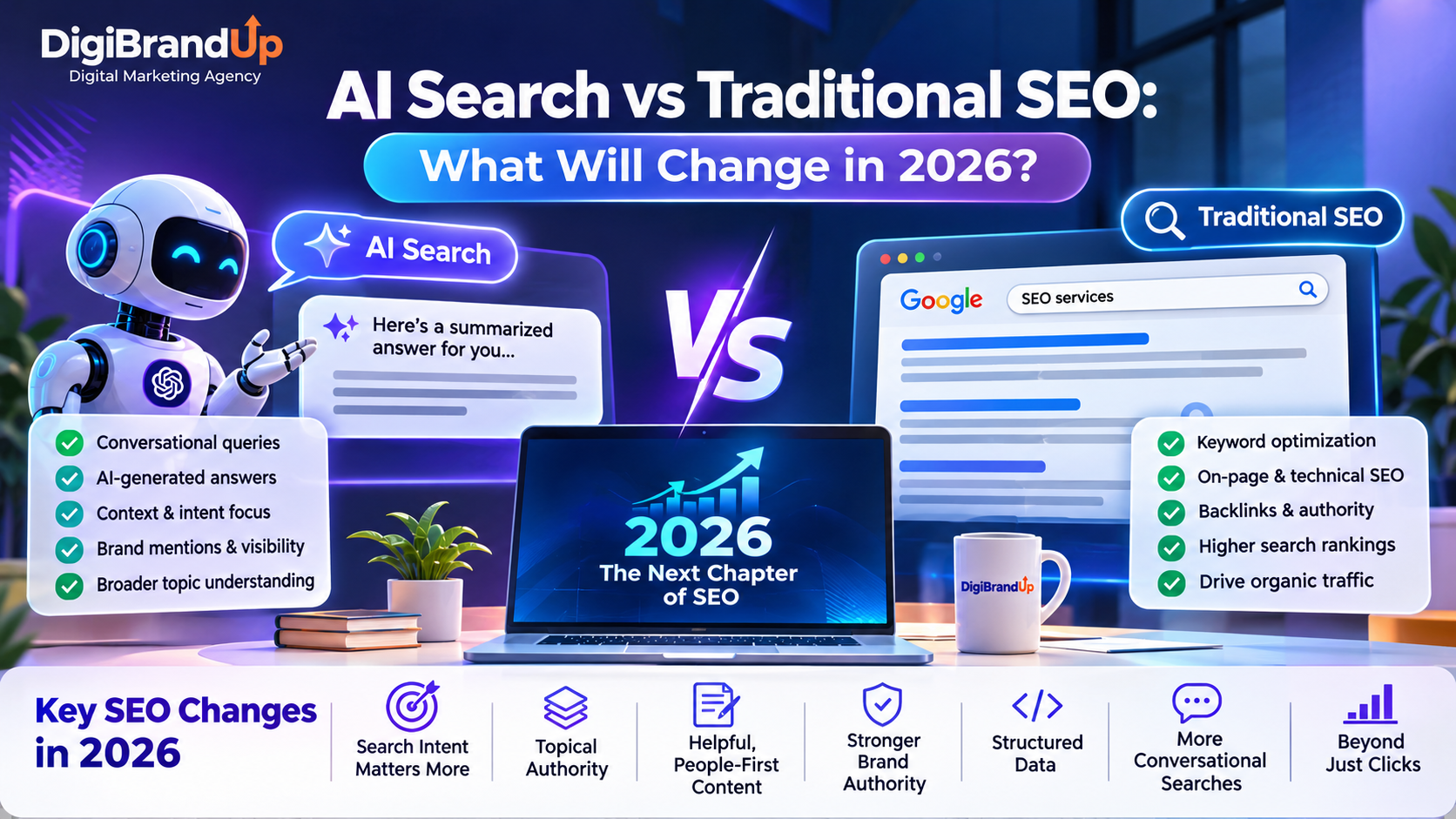
AI Search vs Traditional SEO: What Is the Difference?
The two approaches overlap heavily, but their priorities are slightly different.
| Traditional SEO | AI Search |
|---|---|
| Focuses strongly on rankings | Focuses on visibility within AI-generated answers |
| Keywords are important | Context and intent are increasingly important |
| Organic clicks are a major goal | Brand mentions and answer visibility also matter |
| Individual pages are optimized | Broader topic coverage becomes important |
| Backlinks support authority | Multiple trust and relevance signals matter |
| Short search queries are common | Conversational queries are increasingly important |
| SERP visibility is central | Answer and brand visibility are also important |
The important point is that AI search does not make traditional SEO useless.
In fact, Google’s current documentation continues to emphasize SEO fundamentals while also providing guidance for generative AI features in Search. Google specifically notes that SEO best practices remain relevant for visibility in its generative AI experiences.
What Will Change in SEO in 2026?
1. Search Intent Will Matter More Than Exact-Match Keywords
Keywords still matter, but modern SEO should not depend on repeating one phrase over and over.
Suppose you want to rank for:
“SEO services for small businesses.”
A real customer might search:
- How can a small business get more Google traffic?
- How much does SEO cost for a small company?
- How long does SEO take?
- Should I hire an SEO agency?
- How do I improve my local search ranking?
These searches use different words, but the underlying topic is connected.
Google’s documentation explains that its language systems can understand how pages relate to different queries without requiring every exact keyword variation to appear on the page.
For DigiBrandUp, this means content should be built around customer problems rather than simply inserting a keyword into every heading.
The goal is to answer the question behind the search.
2. Topical Authority Will Become More Important
One article rarely proves that a business understands an entire subject.
Imagine a company providing ecommerce services.
Instead of publishing one generic article called “What Is Ecommerce?”, it could build a complete content cluster covering:
- Shopify vs WooCommerce
- Ecommerce website development
- Ecommerce SEO
- Product page optimization
- Cart abandonment
- Ecommerce conversion rates
- Payment gateways
- Ecommerce website speed
- Product feed optimization
- Ecommerce marketing automation
These articles can connect through internal links and collectively demonstrate broader knowledge.
This approach is useful because search engines need to understand not only what one page discusses, but also what a website is generally knowledgeable about.
For DigiBrandUp, creating connected content around ecommerce, web development and digital marketing can be much more valuable than publishing unrelated articles simply because a keyword happens to be trending.
3. Helpful Content Will Matter More Than Keyword Stuffing
There is a major difference between SEO content and content written for search engines.
SEO content should help the reader first.
Search-engine-first content often looks like this:
Digital marketing is important. Digital marketing helps businesses. Businesses need digital marketing because digital marketing is important.
Technically, congratulations. You have managed to say almost nothing six different ways.
Google’s guidance specifically encourages helpful, reliable and people-first content rather than content created primarily to manipulate search rankings.
A stronger article should include:
- Real examples
- Practical explanations
- Original insights
- Useful comparisons
- Clear answers
- Relevant statistics when available
- Expert experience
- Appropriate external references
That is the kind of content people are more likely to read, share and trust.
4. Brand Authority Will Become More Important
AI search introduces an additional challenge.
Your website may have excellent content, but search systems still need to understand whether your business is a credible source.
That makes brand authority increasingly important.
Businesses should maintain consistent information across:
- Official website
- Business profiles
- Industry directories
- Social media
- Review platforms
- Relevant publications
- Professional communities
This does not mean creating hundreds of low-quality directory listings.
It means building a consistent digital presence that clearly communicates:
Who are you?
What do you do?
Who do you serve?
Why should people trust you?
A strong digital footprint can support both conventional SEO and broader AI-search visibility.
This is particularly relevant for DigiBrandUp, because a digital marketing brand should demonstrate its expertise not only through service pages but also through genuinely useful educational content.
5. Structured Data and Clear Website Information Matter
AI systems and search engines need to understand the information on your website.
Clear website structure helps.
Important business information should be easy to find, including:
- Business name
- Services
- Products
- Location
- Contact information
- About information
- Author information
- FAQs
- Organization details
Structured data can also help search engines understand specific types of information on a page.
However, structured data is not a magic shortcut to AI visibility.
Adding schema does not automatically make a website authoritative.
Think of it as giving search engines clearer labels rather than bribing them with a bag of technical keywords.
Google recommends making content understandable and following the relevant structured-data guidelines where applicable.
6. Conversational Search Queries Will Become More Important
People do not always search using short keywords.
They increasingly ask complete questions.
For example:
Traditional query:
“SEO agency Varanasi”
Conversational query:
“What should a small business in Varanasi look for before hiring an SEO agency?”
The second query gives much more context.
Businesses can prepare by creating content around real customer questions.
Useful formats include:
- How-to guides
- Comparison articles
- FAQs
- Tutorials
- Case studies
- Service guides
- Product comparisons
- Troubleshooting articles
For DigiBrandUp, this could mean creating articles that answer the exact questions customers ask before purchasing digital marketing, web development or ecommerce services.
7. Organic Traffic Will Not Tell the Whole Story
Traditional SEO reporting often focuses on:
- Keyword rankings
- Impressions
- Clicks
- Organic traffic
- Click-through rate
- Conversions
These metrics remain important.
But AI search introduces another layer.
A user might discover your brand while researching a topic through an AI search experience, remember the name, and later search for your company directly.
That journey may not look like a traditional organic click.
So businesses should also monitor:
- Branded searches
- Direct traffic
- Referral traffic
- Assisted conversions
- Engagement
- Returning visitors
- Overall brand visibility
The question is slowly becoming broader than:
“How many keywords do we rank for?”
It is becoming:
“How often does our brand become part of the customer’s research journey?”
How Businesses Can Prepare for AI Search in 2026
You do not need to completely rebuild your SEO strategy.
You need to make it smarter.
Step 1: Fix Your Technical SEO
Start with the basics.
Check whether your website is:
- Mobile-friendly
- Secure
- Crawlable
- Properly indexed
- Fast enough
- Easy to navigate
- Free from major technical errors
Google’s Search Essentials also highlights crawlable links, useful content, descriptive page elements and other foundational practices.
Step 2: Create Topic-Based Content
Stop publishing random blogs simply because someone found a keyword with decent search volume.
Instead, identify the subjects that matter to your business.
For example:
Main topic: Ecommerce
Then build supporting content around it.
This creates a stronger relationship between pages and makes internal linking more meaningful.
Step 3: Answer Real Customer Questions
Talk to your customers.
Talk to sales teams.
Look at support conversations.
Read reviews.
Check questions people ask on forums and communities.
Then turn those questions into content.
This is where DigiBrandUp can differentiate its content strategy from generic agency blogs.
Instead of writing another article saying “SEO is important,” answer questions such as:
“How much should a small business spend on SEO in India?”
That is much closer to real buying intent.
Step 4: Strengthen Your Brand
Publish useful information consistently.
Get involved in relevant industry communities.
Earn legitimate mentions.
Build partnerships.
Collect genuine customer reviews.
Create original research when possible.
The objective is not to manufacture authority.
It is to actually become authoritative.
Step 5: Improve Existing Content
Not every SEO win requires publishing another 2,000-word article.
Sometimes your existing pages need attention.
Review old content and ask:
- Is the information still accurate?
- Does it answer the search intent?
- Are examples outdated?
- Are internal links missing?
- Are external sources relevant?
- Is the title clear?
- Does the introduction answer the question quickly?
- Is there unnecessary filler?
Google’s documentation recommends keeping content useful, unique, reliable and up to date.
For DigiBrandUp, updating strong existing articles can be a better use of time than producing dozens of shallow posts.
Internal Linking: An Important Part of the Strategy
Internal links are especially useful when building topic clusters.
For example, this article can naturally link to your relevant SEO services, digital marketing services, web development services and related educational content on your website.
Use descriptive anchor text instead of generic phrases such as “click here.”
For example:
Businesses that want to improve their organic visibility can explore professional SEO services.
Google’s SEO guidance recommends descriptive link text and explains that links help users and search engines discover and understand related pages.
Important: Replace the example internal URLs above with the exact live URLs of the corresponding DigiBrandUp pages if those pages use different slugs. Do not publish dead links just to satisfy an SEO plugin.
External Links: Why They Matter
A strong article should not pretend that it invented the internet.
When discussing SEO, it makes sense to reference authoritative sources such as Google Search Central.
For example, readers can learn more from the official Google SEO Starter Guide, which covers how search engines discover and understand content.
You can also refer readers to Google Search Essentials for Google’s current technical and spam-related guidance.
For people interested in helpful content, Google’s Creating Helpful, Reliable, People-First Content documentation is another useful resource.
These are authoritative, relevant references rather than random websites added merely to make the article look “SEO optimized.”
Will AI Search Replace Traditional SEO?
No.
At least, there is no good reason to conclude that.
AI search is changing how information is presented, but many of the fundamentals remain relevant.
A search engine still needs to:
- Discover content
- Understand content
- Evaluate relevance
- Assess quality
- Identify trustworthy information
- Connect users with useful sources
That means technical SEO, content quality, internal linking, authority and user experience still matter.
The bigger change is the definition of search visibility.
In the past, marketers could focus heavily on:
“Where does my page rank?”
In an AI-driven search environment, they also need to consider:
“Does the system understand my brand, expertise and content well enough to include it when answering relevant questions?”
That is a much broader SEO challenge.
AI Search and Traditional SEO Should Work Together
The smartest strategy for 2026 is not AI search vs traditional SEO.
It is:
Traditional SEO + AI search optimization + strong brand authority.
Traditional SEO provides the foundation.
AI-focused optimization expands how your content can be discovered and understood.
Brand building creates the credibility that supports the whole strategy.
For DigiBrandUp, this combination can be particularly useful because SEO, web development, ecommerce and digital marketing are closely connected.
A technically strong website with weak content will struggle.
A website with excellent content but poor technical foundations can also struggle.
And a website that gets traffic but fails to build trust will have trouble converting that traffic into customers.
SEO works best when all three parts support each other.
A Practical SEO Strategy for 2026
Here is a simple framework businesses can follow:
Technical Foundation
Make your website accessible, crawlable, fast and mobile-friendly.
Content
Create useful, original content that directly answers customer questions.
Topical Authority
Build connected content around the subjects your business actually knows.
Internal Linking
Connect related pages using descriptive and relevant anchor text.
External Authority
Reference trustworthy sources and earn legitimate mentions from relevant websites.
Brand Building
Make your business recognizable and consistent across the web.
Measurement
Track rankings, organic traffic, conversions, branded searches and overall visibility.
This approach is more sustainable than chasing every new SEO acronym that appears on LinkedIn at 8:00 AM.
Conclusion
AI search is changing SEO, but it is not destroying it.
Traditional SEO still provides the foundation businesses need to be discovered online. Technical optimization, relevant content, internal links, authority and good user experience remain important.
What is changing is the way people interact with search.
Users are asking longer questions, expecting more direct answers, and increasingly relying on AI-powered experiences to research information.
That means businesses need to think beyond individual keyword rankings.
They need to build useful content, topical authority, strong brands and trustworthy websites.
The businesses that adapt will not necessarily be the ones publishing the most content.
They will be the ones creating the most useful content for the right audience.
For DigiBrandUp, the opportunity is clear: combine traditional SEO fundamentals with AI-search awareness, strong content strategy and genuine digital authority.
The future of SEO is not about choosing between humans and algorithms.
It is about building websites that work well for both.
And frankly, that is a much healthier SEO strategy than stuffing the same keyword into a paragraph 37 times and hoping Google takes pity on you.
Frequently Asked Questions
1. Is traditional SEO still important in 2026?
Yes. Traditional SEO remains important because technical SEO, content quality, website structure, internal linking, authority and user experience continue to support search visibility.
2. What is the difference between AI search and traditional SEO?
Traditional SEO focuses heavily on organic rankings and clicks. AI search adds another layer where businesses also need to consider how their content and brand are understood and represented in AI-generated answers.
3. Will AI search replace Google SEO?
No. AI search is changing search behavior, but traditional SEO remains an important foundation. Businesses should prepare for both rather than abandoning conventional SEO.
4. What is GEO in digital marketing?
GEO usually means Generative Engine Optimization. It refers to strategies intended to improve a brand’s visibility within generative AI and AI-powered search experiences.
5. How can a business optimize for AI search?
Start with strong technical SEO, useful people-first content, clear website information, topical authority, relevant internal links, trustworthy external references and consistent brand signals.
6. Does keyword research still matter in AI search?
Yes. Keyword research remains useful for understanding what customers are searching for. However, businesses should use keywords to understand intent and topics rather than simply repeating exact phrases.
7. Should businesses stop investing in traditional SEO?
No. Traditional SEO remains the foundation. AI search should be treated as an additional part of a broader organic search and digital marketing strategy.
8. How important is brand authority for AI search?
Brand authority can become increasingly important because AI-powered search experiences need to identify useful and trustworthy sources. Businesses should therefore focus on consistent information, useful content and genuine industry credibility.