


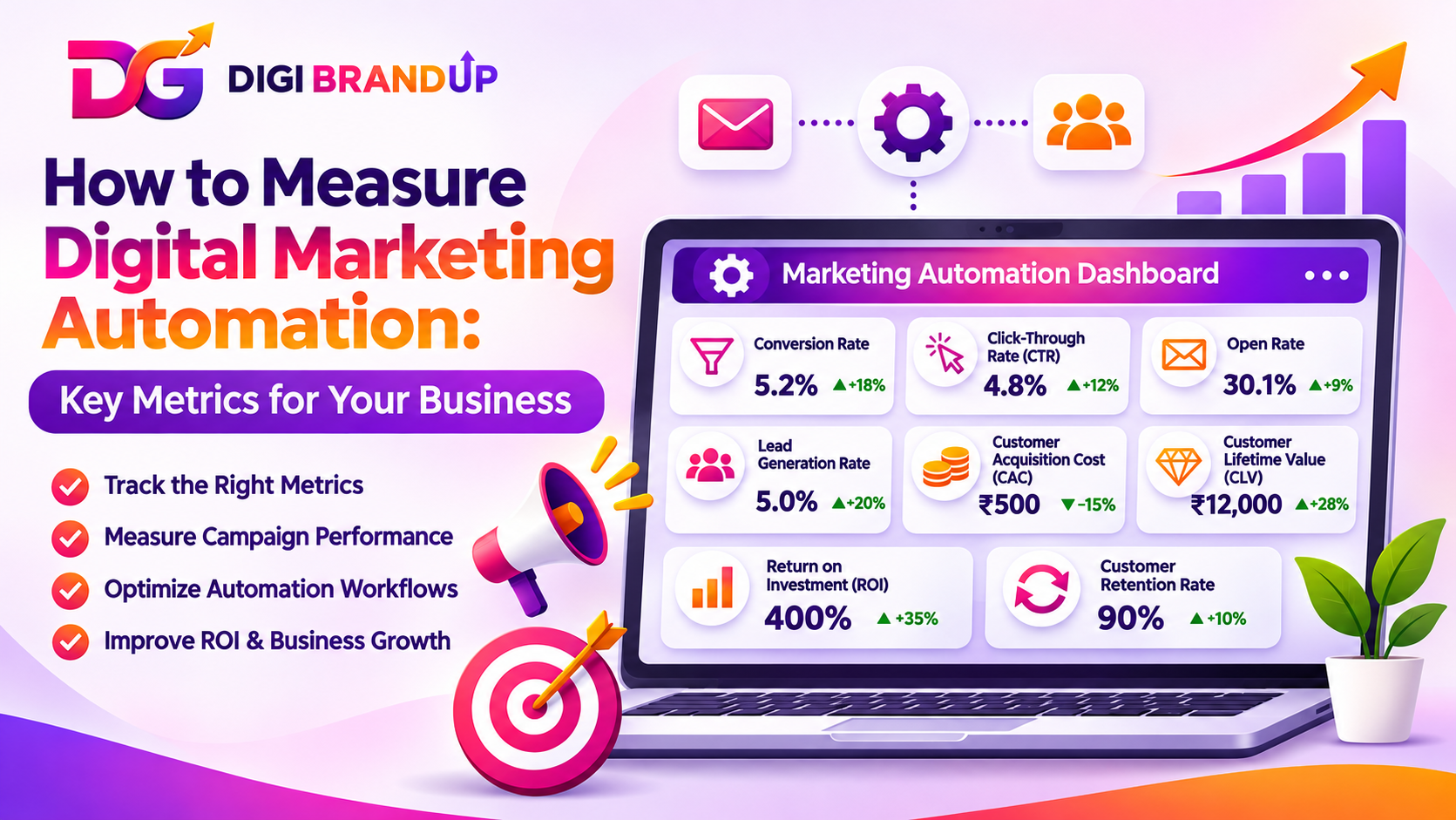
How to Measure Digital Marketing Automation: Key Metrics for Your Business
Marketing automation helps businesses manage repetitive marketing activities, improve customer communication, and generate more qualified leads. However, simply setting up automated emails, follow-up messages, and marketing campaigns does not guarantee better business results.
You need to understand whether your marketing automation strategy is actually working. Are more visitors becoming customers? Are automated campaigns generating revenue? Are customers returning to make repeat purchases?
Tracking the right metrics helps answer these questions. It also shows which campaigns need improvement and where your marketing budget is producing the best results.
In this guide, we will explore the key metrics, practical measurement methods, and tools businesses can use to evaluate marketing automation performance.
Why Measuring Marketing Automation Matters
Implementing marketing automation without tracking its performance is like running an advertising campaign without checking the results. You might be spending money and reaching people, but you will not know whether those activities are helping your business grow.
Measurement gives you a clear picture of campaign performance. It helps identify successful workflows, understand customer behaviour, and reduce unnecessary marketing expenses.
Here are some important reasons to measure your automation efforts:
- Understand campaign performance: Identify which automated campaigns generate engagement and conversions.
- Improve lead quality: Discover whether your workflows attract potential customers who are genuinely interested.
- Increase revenue: Track how automated campaigns contribute to sales and repeat purchases.
- Reduce marketing costs: Identify inefficient activities and improve resource allocation.
- Improve customer experience: Understand whether customers receive relevant messages at the right time.
For example, an online clothing store might automate welcome emails and abandoned cart reminders. Measuring their performance helps the business understand which workflow generates more completed purchases.
8 Key Marketing Automation Metrics Every Business Should Track
Not every metric deserves equal attention. Your business goals should determine what you measure.
However, several important performance indicators can help businesses evaluate their marketing automation activities.
1. Conversion Rate
Conversion rate measures the percentage of users who complete a desired action after interacting with your marketing campaign.
This action could be purchasing a product, submitting an enquiry form, booking a consultation, or registering for a service.
Formula:
Conversion Rate = (Total Conversions ÷ Total Visitors or Recipients) × 100
For example, suppose an automated email reaches 1,000 recipients and 50 people complete a purchase. Your conversion rate is 5%.
A higher conversion rate generally indicates that your campaign is encouraging more people to take action.
However, always compare similar campaigns and use a consistent measurement method.
2. Click-Through Rate (CTR)
Click-through rate measures how many recipients click a link or call-to-action inside your automated marketing messages.
It helps determine whether your content, offers, and messaging encourage customers to explore your products or services.
Formula:
CTR = (Total Clicks ÷ Total Delivered Messages) × 100
For example, if 2,000 emails are delivered and 100 recipients click the product link, your CTR is 5%.
If your CTR is low, review your email content, CTA placement, product relevance, and subject lines.
For email campaigns, distinguish total clicks from unique clicks. Unique clicks provide a clearer view of how many individual recipients interacted with your message.
3. Open Rate
Email open rate measures the percentage of delivered emails recorded as opened by recipients.
It can help you understand whether your subject lines and sender information attract attention.
Formula:
Open Rate = (Recorded Unique Opens ÷ Delivered Emails) × 100
For example, if 1,000 emails are delivered and 300 recorded opens occur, the reported open rate is 30%.
However, open rate is not always reliable. Privacy features and automatic image loading can affect tracking accuracy.
Therefore, do not judge marketing automation success using open rates alone. Give more attention to clicks, conversions, and revenue.
4. Lead Generation Rate
Lead generation rate measures how effectively your automated campaigns turn interested visitors into potential customers.
This metric is particularly useful for service-based businesses, B2B companies, and businesses offering consultations.
Formula:
Lead Generation Rate = (Total Qualified Leads ÷ Total Visitors) × 100
For example, a website receives 2,000 visitors through a campaign and generates 100 qualified leads. Its lead generation rate is 5%.
You should also monitor lead quality. A campaign generating 100 irrelevant enquiries may be less valuable than one generating 30 genuine business opportunities.
5. Customer Acquisition Cost (CAC)
Customer Acquisition Cost measures how much your business spends to acquire a new customer.
Marketing automation can help reduce acquisition costs by improving follow-ups, managing leads, and reducing repetitive manual activities.
Formula:
CAC = Total Sales and Marketing Costs ÷ Number of New Customers Acquired
For example, suppose your business spends ₹30,000 on marketing and sales activities during a campaign and acquires 60 new customers.
Your customer acquisition cost is ₹500 per customer.
Compare CAC across campaigns to identify which marketing activities attract customers more efficiently.
Remember to include relevant software, advertising, and operational expenses when calculating the actual cost.
6. Customer Lifetime Value (CLV)
Customer Lifetime Value estimates the total revenue a business can expect from a customer throughout their relationship with the company.
It helps you understand whether your marketing automation strategy supports long-term customer relationships.
For example, an online skincare store might automatically send product recommendations, replenishment reminders, and personalised offers.
These messages can encourage existing customers to purchase again.
A simple calculation is:
CLV = Average Purchase Value × Purchase Frequency × Customer Lifespan
If a customer spends ₹1,000 per purchase, buys four times annually, and remains a customer for three years, their estimated lifetime revenue is ₹12,000.
Compare customer lifetime value with acquisition costs to understand the long-term value of your marketing activities.
7. Return on Investment (ROI)
Return on Investment measures the financial return generated by your marketing activities compared with their total cost.
It is one of the most important metrics for evaluating marketing automation performance.
Formula:
ROI = [(Revenue Attributed to Campaign − Campaign Cost) ÷ Campaign Cost] × 100
For example, an automated campaign generates ₹50,000 in attributed revenue and costs ₹10,000 to operate.
Its ROI is 400%.
This means the campaign generated ₹4 in net return for every ₹1 invested.
Use a clear attribution method and include relevant expenses. Otherwise, your reported ROI may present an inaccurate picture of campaign performance.
8. Customer Retention Rate
Customer retention rate measures the percentage of customers who continue purchasing from your business over a specific period.
It helps evaluate whether automated communication supports customer loyalty and repeat purchases.
Formula:
Retention Rate = [(Customers at End − New Customers Acquired) ÷ Customers at Start] × 100
For example, if a business starts with 500 customers, ends with 550 customers, and acquires 100 new customers, its retention rate is 90%.
Automated loyalty emails, personalised recommendations, and follow-up messages can support customer retention.
How to Measure Marketing Automation Performance Step by Step
Tracking individual metrics is useful, but businesses also need a consistent measurement process.
Follow these practical steps to evaluate your marketing automation strategy.
Step 1. Define Your Business Goals
Start by identifying what you want to achieve.
Your goals might include increasing online sales, generating qualified leads, recovering abandoned carts, or improving customer retention.
Avoid tracking every available metric without a clear purpose.
For example, an e-commerce business should prioritise conversions, attributed revenue, and repeat purchases. A B2B company may focus more on qualified leads and customer acquisition costs.
Step 2. Select the Right Automation Tools
Choose marketing automation tools that match your business requirements.
Popular options include:
- HubSpot: Useful for CRM, lead management, automated workflows, and campaign reporting.
- Mailchimp: Offers email marketing, audience segmentation, and campaign automation.
- Klaviyo: Particularly useful for e-commerce email and SMS marketing.
- ActiveCampaign: Provides customer segmentation, email automation, and sales workflows.
- Google Analytics 4: Helps measure website activity, key events, and user behaviour.
Before selecting a platform, compare pricing, integrations, reporting capabilities, and available automation features.
Step 3. Set Up Proper Tracking
Your marketing automation system needs accurate tracking to produce useful reports.
Configure campaign tracking, website events, conversion tracking, and appropriate UTM parameters.
For example, you can track whether visitors purchase products after clicking an automated promotional email.
Google Analytics allows businesses to identify important website actions as key events and analyse how users interact with different marketing channels.
Read Google’s official guide to measuring conversions and key events in Google Analytics for more information.
Step 4. Monitor Campaign Performance Regularly
Review your campaign reports weekly or monthly, depending on your business requirements.
Compare important metrics such as conversion rates, click-through rates, qualified leads, acquisition costs, and revenue.
Look for patterns rather than reacting to individual numbers.
For example, if an abandoned cart campaign generates clicks but very few purchases, investigate checkout problems, unexpected delivery charges, or payment difficulties.
Step 5. Test and Improve Your Workflows
Marketing automation should not remain unchanged after implementation.
Test different subject lines, email content, offers, sending times, and CTA placements.
Use A/B testing to compare different versions and identify which performs better.
Make one meaningful change at a time whenever possible. This makes it easier to understand what influenced the results.
Common Mistakes to Avoid When Measuring Marketing Automation
Even well-planned campaigns can produce misleading reports when businesses measure the wrong things.
Avoid these common mistakes:
- Focusing only on open rates: Opens do not necessarily indicate customer interest or purchasing intent.
- Ignoring lead quality: More leads do not automatically mean more business opportunities.
- Using incorrect attribution: Giving every conversion credit to the last interaction can overlook earlier marketing touchpoints.
- Not tracking campaign expenses: Missing software and operational costs can make ROI appear higher than it really is.
- Ignoring customer feedback: Poor communication and excessive messages can damage customer relationships.
- Never reviewing workflows: Customer behaviour and business requirements change over time.
The goal is not to collect more numbers. It is to understand which activities contribute to measurable business outcomes.
How DigiBrandUp Can Help Your Business Improve Marketing Performance
Successful digital marketing requires more than launching campaigns. Businesses need a clear strategy, accurate measurement, and continuous optimisation.
DigiBrandUp helps businesses strengthen their online presence through digital marketing, e-commerce solutions, website development, and SEO services.
With the right approach, businesses can improve campaign performance, understand customer behaviour, and build better online experiences.
For e-commerce businesses, combining customer insights with automated email campaigns can also improve repeat purchases and customer engagement.
You can explore our email automation strategies for Shopify stores to understand how automated customer communication can support online store growth.
Frequently Asked Questions
1. What is marketing automation?
Marketing automation is the use of software to manage repetitive marketing activities automatically. It includes automated emails, lead nurturing, customer segmentation, and follow-up messages. Businesses use marketing automation to save time, improve communication, generate leads, and deliver relevant messages based on customer behaviour.
2. What are marketing automation tools?
Marketing automation tools are software platforms that help businesses manage campaigns, automate customer communication, and track performance. Popular options include HubSpot, Mailchimp, Klaviyo, and ActiveCampaign. The right platform depends on your business size, budget, marketing goals, and integration requirements.
3. What is insurance marketing automation?
Insurance marketing automation uses software to manage customer enquiries, policy reminders, lead follow-ups, and renewal notifications. Insurance companies can use automated workflows to communicate with potential policyholders and existing customers. However, businesses must follow applicable privacy, consent, and insurance communication regulations.
4. How is automation used in B2B marketing?
B2B companies use marketing automation to capture leads, segment audiences, send personalised emails, and nurture potential customers. For example, someone downloading a business guide might automatically receive educational emails, relevant case studies, and an invitation to book a consultation.
5. How to choose marketing automation software?
Choose marketing automation software based on your business goals, budget, customer database, and required features. Compare workflow capabilities, CRM integrations, reporting, ease of use, and scalability. Start with essential features rather than paying for advanced functionality your business does not currently need.
Conclusion
Measuring marketing automation helps businesses understand whether their campaigns generate real results. Track conversion rates, lead quality, acquisition costs, customer lifetime value, and ROI. Use reliable analytics tools and review campaign performance regularly. Most importantly, improve your workflows using actual customer behaviour. A well-measured marketing automation strategy can support sustainable business growth and stronger customer relationships.