


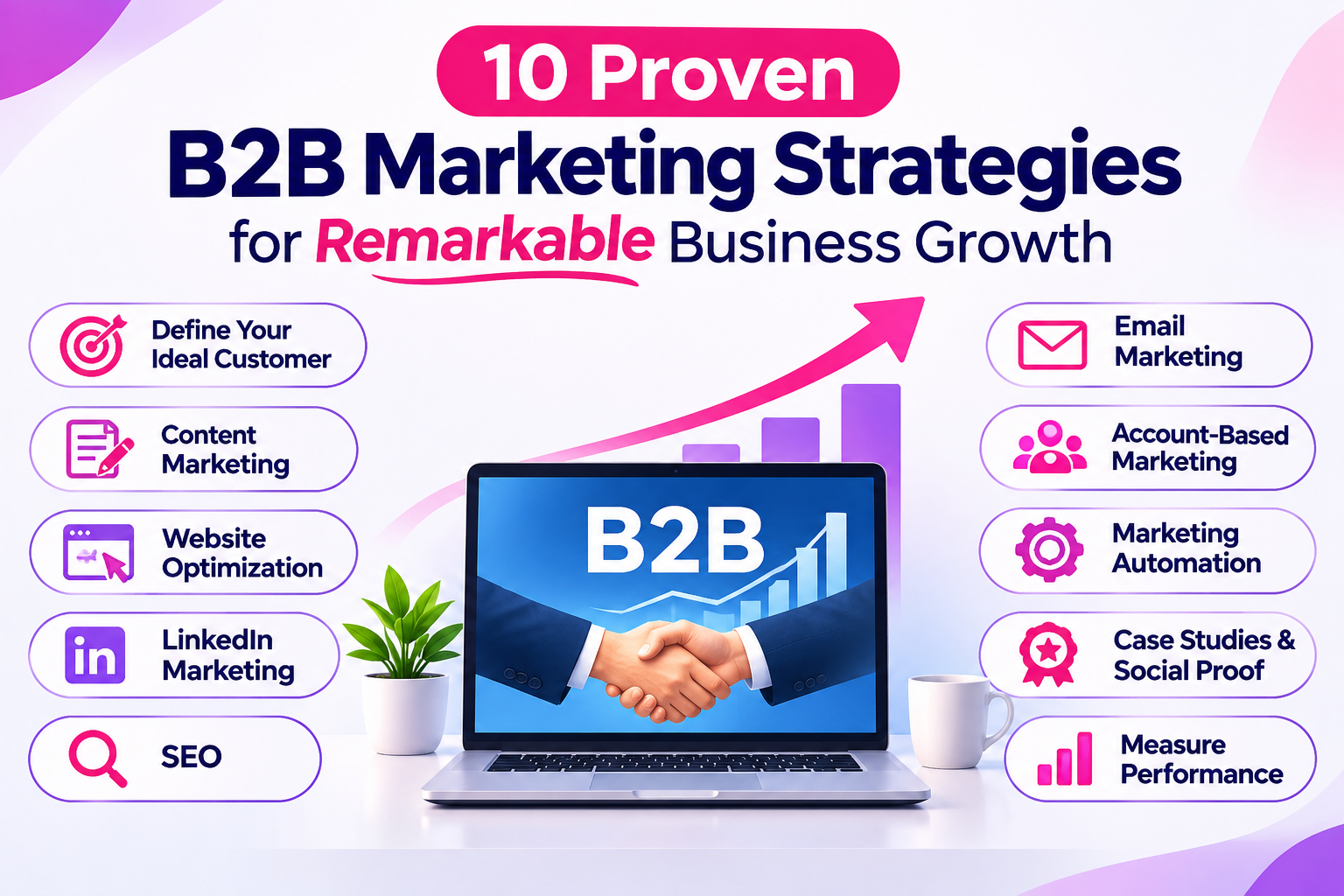
10 Proven B2B Marketing Strategies for Remarkable Business Growth
B2B marketing is no longer limited to cold calls, emails, and traditional sales meetings. Today, businesses need a strong digital presence, useful content, targeted campaigns, and data-driven strategies to attract qualified leads and build long-term relationships.
A well-planned B2B marketing strategy can help businesses generate better leads, improve brand visibility, and increase revenue. Here are 10 proven strategies that can support sustainable business growth.
1. Define Your Ideal Customer Profile
Before launching any marketing campaign, identify exactly who you want to reach. Create an Ideal Customer Profile (ICP) based on industry, company size, location, budget, business needs, and decision-maker roles.
A clear ICP helps your marketing team focus resources on prospects who are more likely to become customers.
2. Build a Strong B2B Content Marketing Strategy
Content is one of the most effective ways to educate potential customers and establish authority.
Create useful content such as:
- Industry guides
- Case studies
- Blog posts
- Whitepapers
- Research reports
- How-to articles
- Comparison guides
Your content should solve real customer problems rather than simply promote your products or services.
For additional insights, businesses can refer to Google Search Central for guidance on creating helpful, people-first content.
3. Optimize Your Website for Lead Generation
Your website is often the first major touchpoint between your business and a potential customer.
Make sure your website clearly communicates:
- What your business offers
- Who you serve
- Why customers should choose you
- How prospects can contact you
Use clear calls-to-action such as Request a Quote, Book a Consultation, or Get Started.
If you need professional website development, explore DigiBrandUp Web Development Services.
4. Use LinkedIn for B2B Lead Generation
LinkedIn is particularly valuable for B2B businesses because it connects companies with professionals and decision-makers.
Instead of constantly posting promotional content, share:
- Industry insights
- Customer success stories
- Educational posts
- Business trends
- Expert opinions
- Short videos
Consistency matters more than posting five times a day and then disappearing for three weeks, a classic human marketing ritual.
5. Invest in SEO
Search engine optimization helps your business appear when potential customers actively search for solutions.
Focus on:
- Commercial keywords
- Service pages
- Location-based keywords
- Long-tail searches
- Technical SEO
- Internal linking
- Helpful content
For example, instead of targeting only B2B marketing, target specific searches such as B2B marketing agency for SaaS companies or B2B lead generation services in India.
You can also explore DigiBrandUp Digital Marketing Services for broader digital marketing support.
6. Use Email Marketing to Nurture Leads
Not every prospect is ready to purchase immediately. Email marketing helps businesses stay connected with potential customers throughout the buying journey.
Create segmented email campaigns based on:
- Industry
- Customer interests
- Previous interactions
- Buying stage
- Business requirements
Instead of sending generic promotional emails, provide useful information that moves prospects closer to a purchasing decision.
7. Use Account-Based Marketing
Account-Based Marketing (ABM) focuses marketing efforts on specific high-value companies rather than targeting a broad audience.
For example, if your company wants to acquire 50 enterprise clients, you can create personalized campaigns specifically for those organizations.
ABM works particularly well for businesses with high-value B2B products or services and longer sales cycles.
8. Combine Marketing Automation with CRM
Marketing automation can reduce repetitive work and improve lead management.
Automation can help with:
- Lead scoring
- Email sequences
- Follow-ups
- Customer segmentation
- Campaign tracking
- Lead nurturing
Integrating marketing automation with a CRM also gives sales teams better visibility into customer interactions.
For CRM and marketing automation best practices, HubSpot Marketing Resources offers useful educational resources.
9. Use Case Studies and Social Proof
B2B buyers often want evidence before making a purchasing decision.
Case studies can demonstrate how your product or service helped a real customer achieve measurable results.
Include details such as:
Problem → Solution → Implementation → Results
Testimonials, reviews, client logos, and industry certifications can also strengthen credibility.
10. Measure Marketing Performance
A successful B2B marketing strategy should be measurable.
Track important metrics such as:
- Website traffic
- Marketing-qualified leads
- Conversion rate
- Cost per lead
- Customer acquisition cost
- Email engagement
- Sales-qualified leads
- Revenue generated
Use tools such as Google Analytics to understand how users interact with your website and marketing campaigns.
Frequently Asked Questions About B2B Marketing Strategies
1. What are B2B Marketing Strategies?
B2B Marketing Strategies are marketing methods used by businesses to attract other businesses as customers. Common B2B Marketing Strategies include SEO, content marketing, LinkedIn marketing, email marketing, account-based marketing, paid advertising, and marketing automation.
2. Which B2B Marketing Strategy is most effective?
There is no single best B2B Marketing Strategy for every business. A combination of B2B SEO, content marketing, LinkedIn marketing, email marketing, and lead generation can produce strong results when aligned with the target audience and sales cycle.
3. How does B2B SEO help business growth?
B2B SEO helps businesses appear when potential customers search for relevant products or services. It is an important part of B2B Marketing Strategies because organic search can continuously generate relevant traffic, leads, and business opportunities.
4. How can content marketing improve B2B lead generation?
B2B content marketing provides useful information that helps prospects understand their problems and possible solutions. Blog posts, case studies, guides, reports, and comparison articles can support different stages of the B2B buying journey and generate qualified leads.
5. Is LinkedIn important for B2B Marketing?
Yes. LinkedIn marketing can be highly valuable for B2B companies because it allows businesses to reach professionals, decision-makers, and industry-specific audiences. Sharing educational content, industry insights, case studies, and business updates can strengthen B2B brand visibility.
6. What is Account-Based Marketing in B2B?
Account-Based Marketing (ABM) is a B2B marketing approach where businesses target specific high-value companies with personalized campaigns. ABM can be particularly useful when a company has a small number of high-value prospects or enterprise customers.
7. How can businesses measure B2B Marketing Strategies?
Businesses can measure B2B Marketing Strategies using metrics such as website traffic, qualified leads, conversion rate, cost per lead, customer acquisition cost, email engagement, sales-qualified leads, and revenue generated from marketing campaigns.
8. Can marketing automation improve B2B lead generation?
Yes. B2B marketing automation can automate repetitive tasks such as email follow-ups, lead nurturing, segmentation, lead scoring, and campaign workflows. This allows marketing and sales teams to focus more on qualified prospects.
9. How long does a B2B Marketing Strategy take to produce results?
The timeline depends on the strategy. B2B SEO and content marketing may require several months to build meaningful organic visibility, while paid campaigns and targeted outreach can generate leads faster. Consistency and measurement are critical for long-term B2B marketing success.
10. Why are B2B Marketing Strategies important for business growth?
Effective B2B Marketing Strategies help businesses attract the right audience, generate qualified leads, build credibility, nurture prospects, and increase conversions. A well-planned B2B Marketing Strategy can ultimately support stronger sales and sustainable business growth.
Conclusion
A successful B2B marketing strategy requires more than advertising. Businesses need a combination of content marketing, SEO, LinkedIn marketing, email campaigns, ABM, automation, and strong measurement.
The most important step is consistency. Choose strategies that match your target audience, measure the results, and continuously improve your campaigns.
For businesses looking to strengthen their online presence, DigiBrandUp can support areas such as digital marketing, web development, e-commerce, and other online growth solutions. You can explore DigiBrandUp to learn more.