


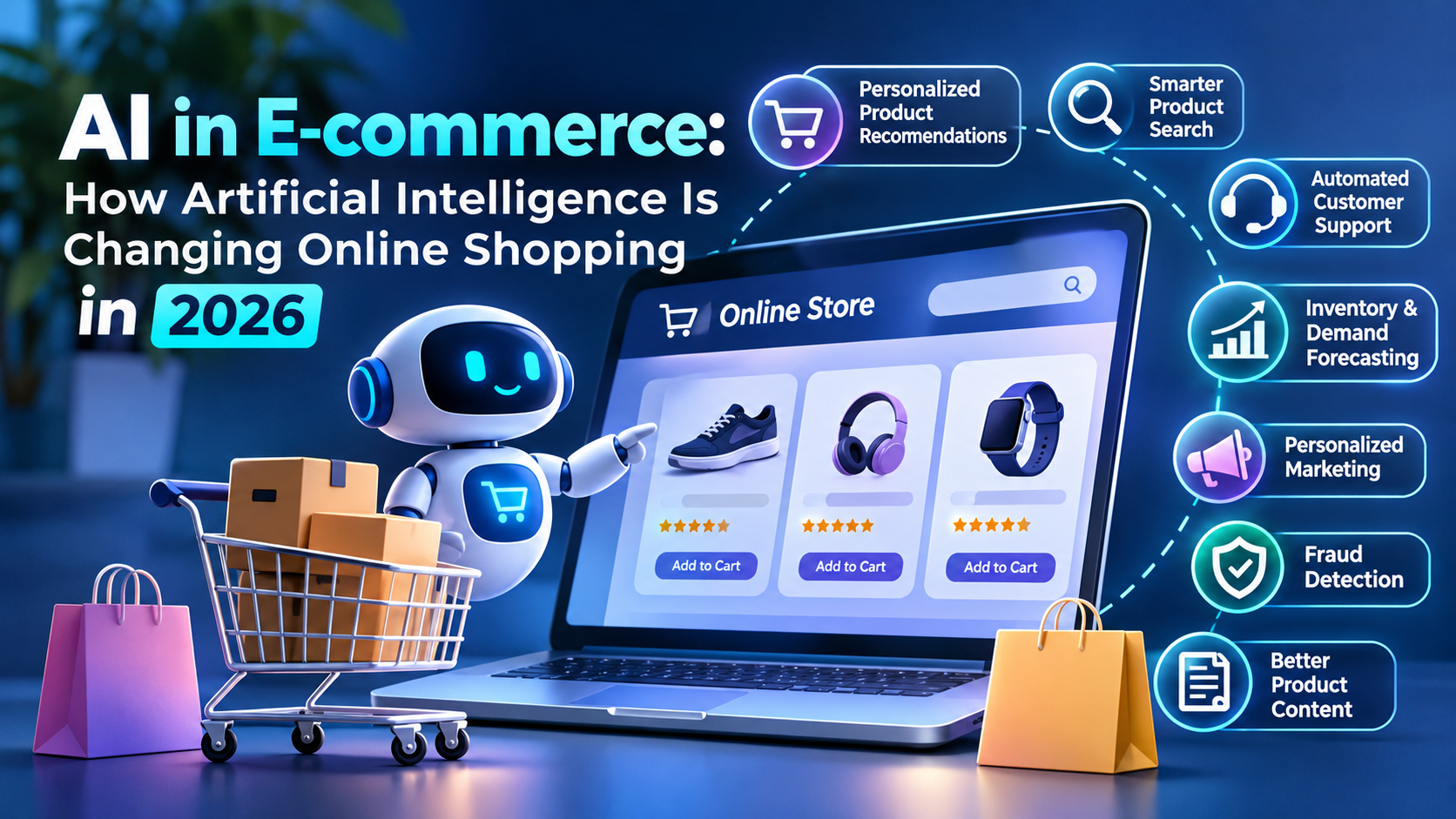
AI in E-commerce: How Artificial Intelligence Is Changing Online Shopping in 2026
Online shopping has changed significantly in recent years. Customers now expect faster product discovery, relevant recommendations, quick answers, simple checkout, and reliable customer support. At the same time, e-commerce businesses have to manage products, orders, marketing, inventory, and customer queries efficiently.
This is where AI in E-commerce is becoming increasingly important in 2026.
From personalized product recommendations and smarter search to automated customer support, demand forecasting, and fraud detection, artificial intelligence is helping online stores improve customer experience while reducing repetitive work.
What Is AI in E-commerce?
AI in E-commerce refers to the use of intelligent technologies to analyze customer behavior, identify patterns, automate repetitive tasks, and support business decisions.
An online store can use these technologies to:
- Recommend relevant products
- Improve product search
- Automate common customer questions
- Predict product demand
- Personalize marketing campaigns
- Detect unusual transactions
- Analyze customer reviews
- Manage large product catalogs
The goal is not to automate everything. The real value comes from using technology where it solves a genuine business problem.
Why Is AI Important for E-commerce in 2026?
Competition in online retail is intense. Customers can compare products, prices, reviews, delivery options, and sellers within minutes.
If an online store provides a poor shopping experience, customers can easily move to another website.
Personalization can help businesses show more relevant products and content to different shoppers. Instead of giving every visitor the same experience, an online store can use available customer data to improve product discovery and engagement.
For businesses looking to improve their complete online store experience, E-commerce Services by DigiBrandUp can be a relevant starting point.
7 Ways AI Is Changing Online Shopping
1. Personalized Product Recommendations
Product recommendations are one of the most common applications of AI in E-commerce.
Recommendation systems can analyze browsing behavior, purchase history, and product interactions to identify products that may be useful to a particular customer.
For example, someone purchasing running shoes may also be interested in sports socks, fitness accessories, or sportswear.
Relevant recommendations can help shoppers discover useful products while creating additional sales opportunities for businesses.
2. Smarter Product Search
Traditional website search often depends heavily on exact keywords.
Modern search systems can better understand the meaning behind a customer’s query.
For example, a shopper might search:
“Black office shoes under ₹2,000.”
A smarter search experience can understand the product type, color, purpose, and price range and return more relevant results.
This becomes particularly valuable for stores with hundreds or thousands of products.
3. Automated Customer Support
E-commerce businesses receive many repetitive questions every day.
Customers commonly ask about:
- Order status
- Delivery time
- Returns and refunds
- Product availability
- Payment options
Automated support systems can handle many basic queries instantly.
This reduces repetitive work for support teams and allows human employees to focus on complex issues that require personal attention.
4. Inventory and Demand Forecasting
Inventory management is one of the biggest challenges in e-commerce.
Too much stock can increase storage costs, while insufficient stock can result in missed sales.
Intelligent forecasting systems can analyze previous sales, seasonal demand, product performance, and other business data to help estimate future requirements.
Better forecasting can reduce overstocking, stockouts, unnecessary discounts, and lost sales.
5. Personalized Marketing
Not every customer responds to the same message.
A first-time visitor may need product information, while an existing customer may be interested in a new product or relevant offer.
Businesses can use customer data to personalize:
- Email campaigns
- Product recommendations
- Promotional offers
- Retargeting campaigns
- Website content
This can make marketing more relevant instead of sending the same message to everyone.
If you’re working on improving organic visibility alongside e-commerce marketing, you can also explore DigiBrandUp’s SEO services.
6. Fraud Detection
Online transactions can attract fraudulent activity.
E-commerce platforms can analyze transaction patterns and identify unusual behavior based on factors such as transaction value, account activity, device information, and purchase frequency.
Early detection can help businesses reduce financial losses and protect customers.
Security is especially important because customer trust can disappear very quickly after a serious security incident.
7. Better Product Content
Product information directly affects purchasing decisions.
Customers want clear details about features, size, materials, specifications, usage, and what is included with a product.
Technology can help businesses organize and improve large product catalogs more efficiently.
However, businesses should still review important information before publishing it. Incorrect specifications can lead to returns, complaints, and loss of customer trust.
AI and Google Shopping
For e-commerce businesses, product information is becoming increasingly important for visibility across search and shopping platforms.
Google recommends providing accurate product data through Google Merchant Center. Google explains that product information helps match products with relevant queries and supports free listings and advertising experiences.
Businesses can also use product structured data on their websites. Google states that combining structured data with Merchant Center product feeds can improve eligibility for richer product experiences and help Google understand product information more effectively.
For more information, businesses can refer to Google’s official e-commerce SEO documentation.
Benefits of AI in E-commerce
When implemented properly, these technologies can provide several benefits.
Better Customer Experience
Customers can find relevant products faster and receive quicker answers to common questions.
Increased Sales Opportunities
Personalized recommendations and improved product discovery can help customers find additional products that match their needs.
Reduced Manual Work
Repetitive tasks such as basic support queries, product categorization, and certain marketing activities can be automated.
Better Business Decisions
Businesses can analyze customer behavior, sales patterns, and product performance to make more informed decisions.
Improved Inventory Management
Demand forecasting can help businesses plan inventory more efficiently and reduce unnecessary stock problems.
Challenges of Using AI in E-commerce
Despite its benefits, AI in E-commerce is not a magic solution.
Businesses need to consider several challenges.
Data privacy: Customer information must be collected and handled responsibly.
Implementation costs: Advanced solutions may require investment in software, integration, and skilled professionals.
Data quality: Poor-quality data can produce inaccurate recommendations and predictions.
Customer trust: Businesses should be transparent about how customer information is used.
Over-automation: Not every customer problem should be handled by an automated system. Some situations still require human judgment.
How Small E-commerce Businesses Can Start
Small businesses do not need to build complicated systems from day one.
A practical approach is to start with areas where technology can produce measurable results.
For example:
- Improve product search and filtering.
- Automate frequently asked customer questions.
- Add relevant product recommendations.
- Personalize email marketing.
- Analyze customer behavior and sales data.
- Improve inventory planning.
The goal should be solving a real business problem, not adopting technology simply because it is trending.
The Future of AI in E-commerce
Online shopping is likely to become more personalized, conversational, visual, and automated.
Instead of searching for products using short keywords, customers may increasingly describe what they need in natural language.
For example:
“I need a lightweight laptop for college and programming under ₹60,000.”
A smarter shopping experience could understand these requirements and help narrow down relevant products.
This shift is already visible in the way commerce platforms are connecting online stores with conversational shopping experiences. Shopify announced in January 2026 that it was expanding commerce integrations across AI-driven shopping channels and introducing the Universal Commerce Protocol with Google.
Visual search, personalized recommendations, automated support, and intelligent product discovery are likely to become increasingly important as online shopping evolves.
Final Thoughts
AI in E-commerce is changing how online stores understand customers, manage products, improve marketing, and deliver better shopping experiences.
Personalized recommendations, smarter search, automated customer support, demand forecasting, fraud detection, and improved product content can help businesses operate more efficiently while making shopping easier for customers.
However, technology alone cannot make an e-commerce business successful.
Product quality, competitive pricing, website performance, delivery, customer service, security, and customer trust still matter.
The smarter strategy for 2026 is to use technology where it creates genuine value for both the customer and the business.
Frequently Asked Questions
What is AI in E-commerce?
AI in E-commerce refers to using intelligent technologies to improve online shopping, customer service, product recommendations, marketing, inventory management, search, and other business processes.
How does AI improve online shopping?
It can help customers find relevant products faster, receive personalized recommendations, get quicker support, and enjoy a smoother shopping experience.
Can AI increase e-commerce sales?
It can create additional sales opportunities through personalization, product recommendations, improved search, and better customer engagement. Results depend on how effectively the technology is implemented.
How can small businesses use AI in E-commerce?
Small businesses can start with automated customer support, product recommendations, marketing automation, better search, and sales or inventory analysis.
What are the biggest challenges?
Common challenges include data privacy, implementation costs, poor-quality data, customer trust, security, and excessive automation.
Conclusion
AI in E-commerce is changing the way online businesses understand customers, manage products, and improve the shopping experience. From personalized recommendations and smarter search to automated customer support, inventory forecasting, and fraud detection, these technologies can help e-commerce businesses work more efficiently and serve customers better.
However, technology alone cannot guarantee success. Product quality, pricing, website performance, delivery, customer service, and trust still matter. The businesses that use technology to solve real customer problems, rather than simply following trends, will be better positioned to compete in the evolving e-commerce market in 2026.