
SEO vs Paid Ads: Which Is Better for Small Businesses in 2026?
Every small business wants more customers, better visibility, and consistent sales without spending more money than necessary. The challenge is deciding where to invest your marketing budget. Should you focus on search engine optimization (SEO) to attract organic traffic, or should you run paid advertisements to reach potential customers faster?
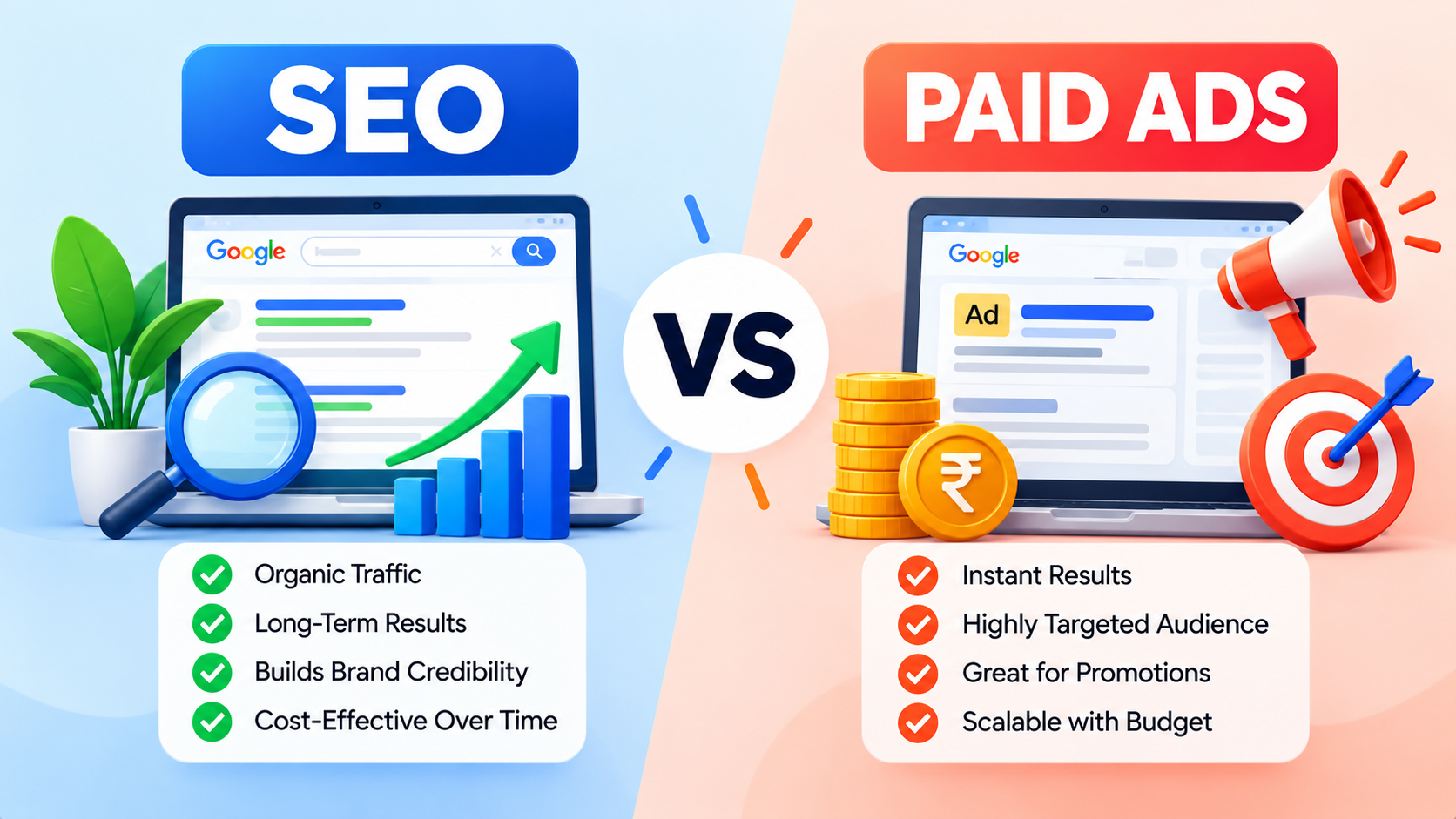
The debate around seo vs paid ads is important because both strategies help businesses reach people who are searching for products or services. However, they work differently, require different budgets, and produce results on different timelines.
SEO helps your website become more visible in unpaid search results. Paid advertising allows you to pay for placements on platforms such as Google and Meta. One can build long-term visibility, while the other can help you reach a targeted audience quickly.
For small businesses, the right choice depends on your goals, competition, available budget, website quality, and how quickly you need leads or sales.
In this guide, we will compare seo vs paid ads across cost, speed, long-term growth, lead generation, return on investment, and practical business situations. You will also learn when to choose each strategy and how to combine them for better results in 2026.
What Is SEO?
Search engine optimization is the process of improving a website so that its pages can appear more prominently in organic search results.
When someone searches for a service such as “best web development company in Varanasi,” Google tries to show pages that are relevant and useful for that search. SEO helps businesses improve their chances of appearing for relevant queries.
SEO includes several activities:
- Keyword research
- Helpful content creation
- On-page optimization
- Technical SEO
- Internal linking
- Website speed improvements
- Mobile usability
- Local SEO
- Link earning and authority building
For example, a web development company can publish useful articles about website costs, e-commerce development, and website maintenance. It can also optimize its service pages for relevant local searches.
Over time, these pages may attract visitors who are actively looking for its services.
In the seo vs paid ads comparison, SEO is generally the longer-term approach. It can continue attracting visitors after a page ranks, although rankings and traffic are never guaranteed.
Businesses can learn the fundamentals through Google’s official SEO Starter Guide.
What Are Paid Ads?
Paid advertising allows businesses to pay platforms to display promotional messages to selected audiences.
Common paid advertising channels include Google Ads, Meta Ads, LinkedIn Ads, and other advertising networks.
With Google Search Ads, businesses can target people searching for specific products or services. Social media advertising can help businesses reach audiences based on factors such as interests, demographics, and platform behavior.
Paid campaigns may use different pricing models, including cost per click (CPC) and cost per thousand impressions (CPM).
For example, a local dental clinic could run Google Ads targeting people searching for dental services in its city. An e-commerce store could use Meta Ads to promote a product to potential customers.
The main advantage in the seo vs paid ads debate is speed. Once a campaign is approved and begins serving, it can start generating impressions, clicks, and potentially leads.
However, paid traffic usually stops when the campaign stops spending, unless the business has other channels bringing visitors.
Businesses can explore Google’s official Google Ads website to understand available campaign options.
SEO vs Paid Ads: The Main Differences
Both approaches can bring relevant visitors to a business website, but their operating models are different.
| Factor | SEO | Paid Ads |
|---|---|---|
| Traffic source | Organic search results | Paid placements |
| Initial cost | Content, technical work, and expertise | Advertising budget plus campaign management |
| Speed | Usually takes time | Can start generating traffic quickly |
| Long-term potential | Can build lasting organic visibility | Traffic depends on active campaigns and budget |
| Budget control | Investment is less directly tied to each click | Spending can be controlled through campaign budgets |
| Competition | Compete for organic rankings | Compete through bids, relevance, and ad quality |
| Main risks | Ranking changes and slow progress | Rising costs and poor campaign performance |
| Best use | Long-term visibility and organic discovery | Immediate reach, testing, and targeted acquisition |
The right choice in seo vs paid ads depends on what the business needs now and what it wants to achieve over the next year.
A business looking for leads this week may prioritize paid campaigns. A business building a long-term online presence may prioritize SEO. Many businesses benefit from using both.
1. SEO vs Paid Ads: Which Produces Faster Results?
Speed is one of the biggest differences between these marketing methods.
How quickly SEO works
SEO usually requires time because search engines need to discover, crawl, understand, and evaluate your pages. Your results also depend on competition, website quality, content relevance, and the authority of your website.
A new website targeting competitive keywords may need several months of consistent work before seeing meaningful results. Less competitive searches can sometimes produce improvements sooner.
SEO is therefore better viewed as an ongoing investment rather than a quick fix.
How quickly paid ads work
Paid advertising can begin generating impressions and clicks soon after campaigns are approved and launched.
However, quick traffic does not automatically mean profitable sales. Campaigns still need relevant keywords, suitable landing pages, effective ads, conversion tracking, and regular optimization.
In the seo vs paid ads comparison, paid ads generally offer faster access to potential customers, while SEO can build organic visibility over time.
Best choice: Use paid ads when you need to test an offer or generate leads quickly. Invest in SEO when you want to build long-term search visibility.
2. Which Is More Affordable for Small Businesses?
Budget is often the deciding factor for a small business.
However, comparing SEO and paid ads only by their initial cost can be misleading.
SEO costs
SEO may require investment in:
- Content creation
- Keyword research
- Technical improvements
- Website development
- SEO tools
- Local SEO
- Professional SEO services
Even when you do the work yourself, SEO requires time and effort.
The advantage is that you do not pay Google for every organic click. A well-performing page may continue attracting visitors without a separate charge for each visit.
Paid advertising costs
Paid campaigns require an advertising budget. You may also need to pay for campaign management, landing page development, creative production, and conversion tracking.
Costs vary depending on the industry, audience, location, keyword competition, and campaign quality.
In the seo vs paid ads decision, the affordable option is the one that produces useful business outcomes within your budget.
For example, a local service provider with a limited budget might start with local SEO and a small, tightly targeted search campaign rather than advertising across several platforms at once.
3. Which Strategy Offers Better ROI?
Return on investment (ROI) measures how effectively your marketing investment generates financial returns.
Neither SEO nor paid advertising automatically delivers a better ROI.
Measuring SEO ROI
SEO results may include organic traffic, qualified leads, sales, and assisted conversions.
To evaluate performance, track how much you spend on SEO and compare it with the business value generated by organic search.
Remember that results may build gradually, so a short evaluation period can underestimate the value of SEO.
Measuring paid advertising ROI
Paid campaigns provide measurable data such as impressions, clicks, cost per click, conversions, cost per lead, and advertising revenue.
For an e-commerce store, you can compare advertising costs with revenue and profit generated by the campaign.
For a service business, track how many leads become paying customers rather than judging campaigns by form submissions alone.
When evaluating seo vs paid ads, look beyond traffic. A campaign generating 500 visitors and no sales may be less valuable than one generating 50 visitors and five qualified leads.
Best practice: Track leads, sales, customer acquisition cost, and profit wherever possible.
4. SEO vs Paid Ads for Local Businesses
Local businesses often serve customers in a particular city or service area. Examples include clinics, restaurants, repair services, agencies, salons, and consultants.
Both SEO and paid ads can help these businesses reach nearby customers.
When local SEO works well
Local SEO helps your business appear for relevant searches, particularly when your website and business information clearly communicate what you offer and where you operate.
Useful activities include:
- Optimizing service pages for relevant locations
- Maintaining accurate business information
- Building a complete Google Business Profile
- Collecting genuine customer reviews
- Creating useful local content
- Keeping contact details consistent
- Making your website mobile-friendly
For example, a web development company targeting Varanasi can create a dedicated service page explaining its services, process, portfolio, and local relevance.
Local SEO can support ongoing discovery from people searching for services in that area.
When paid ads work well locally
Paid search campaigns can target specific locations and relevant service queries. They may be useful when a business needs more enquiries quickly or wants to promote a particular offer.
In the seo vs paid ads comparison, local SEO can build sustained visibility, while paid ads can help fill short-term demand.
A practical strategy is to use local SEO as the foundation and run focused advertising campaigns for high-value services.
5. Which Is Better for E-Commerce Businesses?
E-commerce businesses have different needs from service businesses because they must attract shoppers, communicate product value, and convert visits into orders.
Benefits of SEO for e-commerce
E-commerce SEO can help product pages, category pages, and useful buying guides appear for relevant searches.
For example, an online store selling home décor products could optimize category pages and publish helpful guides about choosing products, comparing materials, or decorating small spaces.
SEO may attract shoppers who are researching products as well as those who are ready to buy.
Benefits of paid ads for e-commerce
Paid campaigns can promote products, offers, and seasonal collections. Shopping-focused advertising can also display product information to people searching for relevant items.
Paid social campaigns may help introduce products to new audiences and test creative ideas.
In the seo vs paid ads comparison, SEO can support long-term product discovery, while paid ads can help test demand and promote products during important sales periods.
The best choice depends on product margins, average order value, conversion rate, repeat purchases, and customer acquisition costs.
6. SEO vs Paid Ads for Building Brand Awareness
Brand awareness means helping more people recognize and remember your business.
SEO can build awareness when your website appears for educational searches, product comparisons, and industry-related questions.
Paid advertising can put your message in front of a defined audience, even when those people are not actively searching for your business.
For example, a new fitness brand might use paid social advertising to introduce its products while publishing SEO-focused guides that answer questions about workout equipment.
Both approaches can contribute to brand growth, but they work through different discovery mechanisms.
When considering seo vs paid ads, think about whether your audience is actively searching for a solution or needs to discover your brand first.
Search advertising is often useful for capturing existing demand. Social advertising can be useful for introducing products and offers to relevant audiences.
7. Can SEO and Paid Ads Work Together?
Yes. Small businesses do not need to treat these strategies as competing choices.
Combining SEO and paid advertising can help a business generate short-term traffic while building long-term visibility.
Use paid ads to test keywords
Paid search campaigns can reveal which search terms generate relevant enquiries or sales.
Those insights can inform your SEO priorities, although paid results do not guarantee that the same keywords will perform equally well in organic search.
Use SEO to build long-term content
Publish useful content around the topics your customers search for. Optimize important service and product pages, improve internal linking, and address technical problems.
Use both for important offers
Paid campaigns can promote a time-sensitive offer while organic content supports broader discovery.
Track both channels properly
Use analytics and conversion tracking to understand which channels introduce customers, which assist conversions, and which generate sales.
In the seo vs paid ads debate, a combined strategy can be practical because it balances immediate reach with long-term organic growth.
However, combining both is not always the right first step for a business with a very limited budget. Start with the channel most closely connected to your immediate goal.
8. Common Mistakes Small Businesses Should Avoid
Choosing the right channel is only part of the job. Poor execution can waste money on either strategy.
Expecting instant SEO rankings
SEO takes time, particularly in competitive markets. Avoid judging a strategy after only a few days.
Running ads without conversion tracking
Clicks do not prove that advertising is generating profitable business. Track enquiries, purchases, and lead quality.
Targeting overly broad keywords
A small business may waste its budget by targeting searches that are too general or unrelated to its services.
Sending visitors to weak landing pages
Even relevant traffic may not convert if the website is slow, confusing, or missing essential information.
Ignoring customer intent
A person searching for “what is SEO” may be researching a topic, while someone searching for “SEO services for small business” may be comparing providers.
Your content and advertisements should match the intent behind the search.
Measuring only rankings or clicks
Rankings and clicks are useful indicators, but they are not the final business objective. Track qualified leads, sales, and revenue.
A thoughtful seo vs paid ads strategy focuses on business results rather than attractive dashboard numbers.
9. How to Choose the Right Strategy for Your Business
Before spending money, answer five questions.
What is your main goal?
If you need enquiries quickly, paid search may be useful. If you want to build organic traffic over time, SEO deserves attention.
How competitive is your market?
Highly competitive keywords can be difficult to rank for organically and expensive to advertise against. Consider more specific, relevant searches.
What is your budget?
A limited budget may require focusing on one or two channels instead of spreading resources across every available platform.
Is your website ready?
Your website should explain your offer clearly, work well on mobile, load reliably, and provide an easy way to contact you or purchase.
Can you measure results?
Without conversion tracking, it becomes difficult to know whether your investment is working.
The best seo vs paid ads decision is the one that matches your business objectives, customer behavior, available resources, and ability to measure results.
10. A Practical 90-Day Marketing Plan for Small Businesses
If you are unsure where to start, use a simple 90-day plan.
Month 1: Build the Foundation
Review your website, identify your key services or products, research relevant keywords, and check your analytics setup.
Fix important technical issues and improve your main landing pages.
If immediate leads are necessary, launch a small, focused paid campaign with clear conversion tracking.
Month 2: Improve Performance
Review which pages attract relevant organic traffic and which paid keywords generate enquiries.
Improve underperforming landing pages, refine advertising targeting, and create helpful content around customer questions.
Remove irrelevant search terms from paid campaigns where appropriate.
Month 3: Invest in What Works
Compare qualified leads, sales, customer acquisition costs, and revenue across channels.
Continue investing in activities that show evidence of business value. Adjust campaigns and content that attract visitors but fail to convert.
This approach allows small businesses to evaluate seo vs paid ads using real performance data rather than assumptions.
How DigiBrandUp Can Help
Choosing between SEO and paid advertising is easier when your marketing strategy is connected to your website, audience, and business goals.
DigiBrandUp offers services related to SEO, digital marketing, web development, e-commerce, and dropshipping.
If your business needs a stronger search presence, explore DigiBrandUp’s services. You can also visit the DigiBrandUp Blog for more practical information about website development, e-commerce, SEO, and digital marketing.
A professional website, relevant content, well-targeted campaigns, and accurate tracking can work together to help you attract visitors and convert them into customers.
Frequently Asked Questions
Is SEO better than paid ads for small businesses?
SEO can be a strong choice for building long-term organic visibility, while paid ads can help generate traffic and enquiries faster. The right option depends on your goals, budget, competition, and timeline.
How long does SEO take to produce results?
SEO timelines vary. Some improvements may appear relatively quickly, while competitive keywords can take months or longer. Results depend on website quality, competition, content, technical factors, and other signals.
Are paid ads worth it for a small business?
Paid ads can be worthwhile when campaigns target relevant customers, landing pages convert effectively, and the business can acquire customers at a sustainable cost. Results should be measured rather than assumed.
Can I use SEO and paid ads together?
Yes. Paid advertising can help generate immediate traffic and test offers, while SEO builds organic visibility over time. Both channels should have clear goals and reliable conversion tracking.
Which is cheaper, SEO or paid ads?
Neither is always cheaper. SEO requires investment in content, technical work, and expertise. Paid advertising requires media spend and often management costs. Compare the total cost with qualified leads, sales, and revenue generated.
Should a new website start with SEO or paid ads?
A new website should first have a clear offer, good landing pages, and proper analytics. If immediate demand is important, a small paid campaign may help. SEO should also begin early because organic visibility takes time to develop.
Does SEO guarantee first-page rankings?
No. No legitimate SEO provider can guarantee a specific Google ranking. Search results depend on competition, relevance, website quality, and many changing factors.
How do I measure marketing ROI?
Track costs alongside qualified leads, completed sales, revenue, and profit. For lead-generation businesses, connect marketing leads with actual sales wherever possible.
Final Thoughts
The choice between SEO and paid advertising does not have to be complicated.
SEO helps businesses build organic search visibility, publish useful content, and attract relevant visitors over time. Paid ads help businesses reach targeted audiences quickly and test offers, keywords, and campaigns.
When comparing seo vs paid ads, avoid looking for one universal winner. Focus on what your business needs, how much you can invest, and which channel can realistically support your goals.
If you need enquiries quickly, consider a focused paid campaign. If you want to build a stronger long-term online presence, invest in SEO. If your budget and resources allow it, use both with clear objectives and reliable tracking.
Most importantly, measure qualified leads, sales, customer acquisition costs, and revenue rather than relying only on clicks or impressions.
A sensible marketing strategy is not about spending the most money. It is about understanding your customers, choosing the right channels, and improving your results consistently.