

Best Uses of AI in Digital Marketing: A Complete Guide
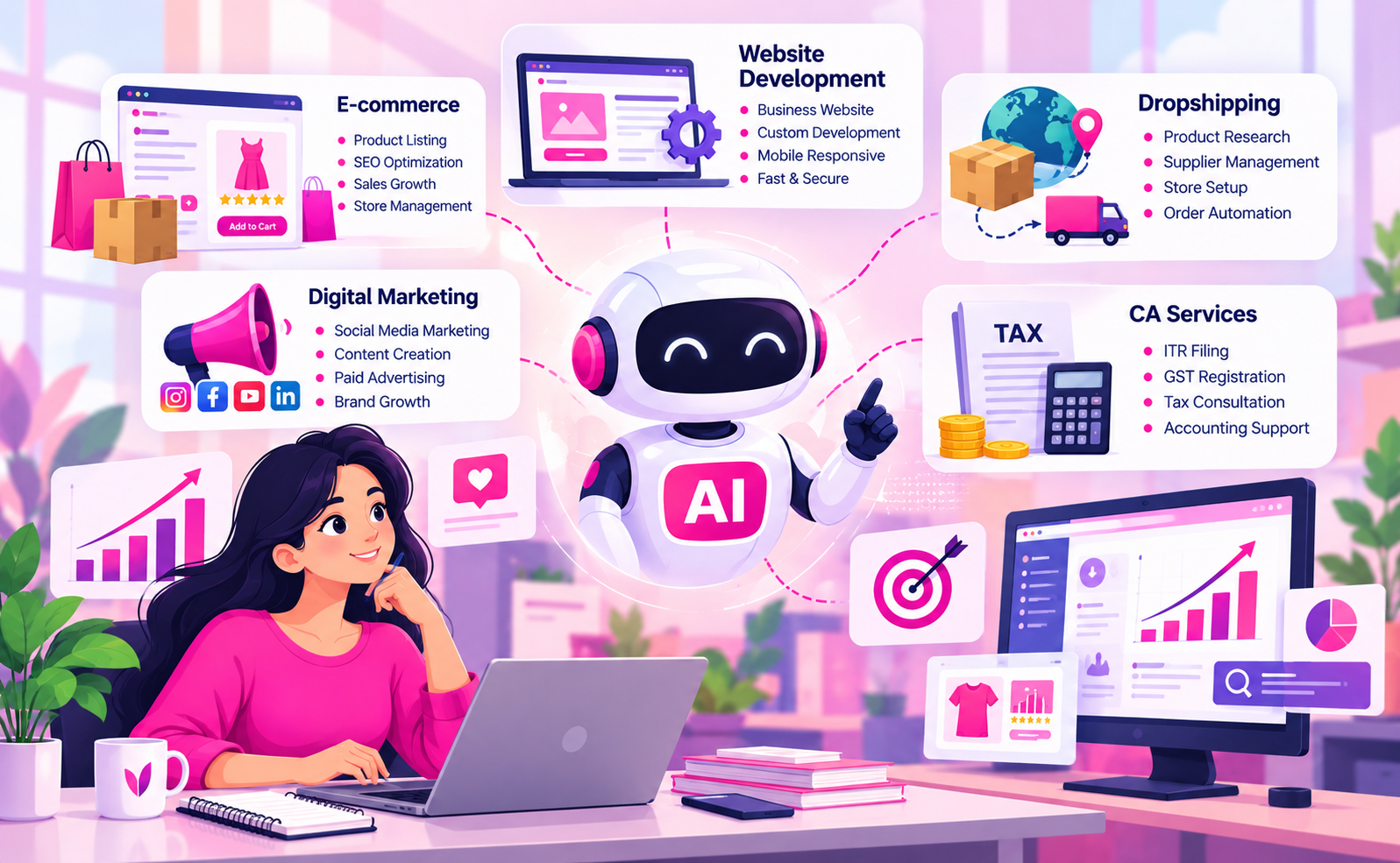
Digital marketing has changed a lot over the past few years. Businesses no longer depend only on manual research, traditional advertising methods, or guesswork to reach potential customers. Today, AI in digital marketing helps businesses understand customer behaviour, create content, manage advertising campaigns, improve search visibility, and make better marketing decisions.
For small businesses, startups, e-commerce stores, and established brands, AI in digital marketing can save time and make daily marketing tasks easier. However, using AI without a proper strategy can waste money and produce content that sounds similar to everything else on the internet.
The real benefit of AI in digital marketing comes from combining technology with human creativity, customer understanding, and business goals. Whether you manage social media accounts, run Google Ads, publish blog posts, or sell products online, AI tools can support your work at different stages.
In this guide, we will explore the best uses of AI in digital marketing, practical applications, useful tools, and the ways businesses can use these technologies to improve their marketing performance in 2026.
1. AI in Digital Marketing for Content Creation
Creating quality content consistently is one of the biggest challenges for digital marketers. Businesses need blog posts, website copy, social media captions, product descriptions, email campaigns, and advertisements. Producing everything manually takes time, especially when a marketing team manages multiple clients or platforms.
AI in digital marketing can help generate content ideas, prepare outlines, organise research, and develop initial drafts. Marketers can use these suggestions to create content that matches their audience’s interests and search intent.
For example, an e-commerce business selling clothing can use AI to prepare product description drafts, social media captions, and promotional email ideas. An agency can use AI in digital marketing to plan blog topics and organise content calendars for different clients.
However, publishing every AI-generated draft without checking it is a mistake. Content still needs accurate information, a natural writing style, original insights, and proper editing. AI should help the writer work faster, not replace the thinking required to produce useful content.
2. AI in Digital Marketing for SEO
Search engine optimisation involves keyword research, content planning, technical analysis, internal linking, and ongoing performance monitoring. AI in digital marketing can support several of these activities by helping marketers identify patterns and organise large amounts of information.
AI-powered SEO tools can suggest related keywords, group search terms by intent, analyse content gaps, and identify topics that deserve attention. Some tools can also help review page structure, generate title ideas, and prepare content briefs.
For example, a local business targeting customers in Varanasi may want to rank for service-related searches. AI in digital marketing can help organise relevant keyword variations and suggest useful supporting topics for the website.
Still, keyword suggestions are not proof that a term has strong search demand. Marketers should verify search volume, competition, and actual performance through tools such as Google Search Console and other keyword research platforms.
Google also explains its approach to AI-generated content in its official guidance on creating helpful, reliable, people-first content. The important point is to create genuinely useful content rather than publish pages simply to manipulate search rankings.
3. AI in Digital Marketing for Social Media Management
Managing multiple social media platforms can become a full-time job. Businesses need fresh content, suitable captions, creative ideas, consistent publishing schedules, and timely responses to customer comments.
AI in digital marketing can help teams brainstorm post ideas, adapt content for different platforms, draft captions, and analyse engagement patterns. A single useful blog post, for example, can be turned into several social media topics instead of being used only once.
AI tools can also help marketers identify common audience questions and prepare responses for frequently asked queries. This makes social media management more organised and reduces repetitive work.
However, publishing more posts does not automatically produce more customers. Businesses should measure meaningful results such as qualified enquiries, website visits, conversions, and sales instead of focusing only on likes and follower counts.
4. AI in Digital Marketing for Paid Advertising
Paid advertising requires continuous testing and careful budget management. Businesses must choose suitable audiences, develop effective creatives, write compelling advertisements, and monitor campaign performance.
AI in digital marketing can help generate different ad copy variations, suggest creative concepts, analyse campaign data, and support automated bidding or audience optimisation features offered by advertising platforms.
For example, a business running Google Ads can test multiple headlines and descriptions to understand which combinations attract relevant visitors. An e-commerce brand can analyse product performance and adjust its campaigns according to sales data and profitability.
The key is to judge advertising by business outcomes. More clicks do not necessarily mean more revenue, and a campaign with low acquisition costs can still perform poorly if the leads are irrelevant.
Businesses should establish conversion tracking, define clear campaign objectives, and review results regularly. AI in digital marketing works best when it receives reliable data and operates within a sensible budget.
5. AI in Digital Marketing for Customer Personalisation
Customers expect brands to provide relevant information instead of sending the same message to everyone. AI in digital marketing can help businesses organise customer segments and tailor messages according to shopping behaviour, previous interactions, and stated preferences.
An online store might recommend related products based on a customer’s browsing history. A service business might send different follow-up emails to people who downloaded a guide and people who requested a quotation.
Personalisation can also improve email marketing by helping marketers test subject lines, organise audience segments, and identify suitable times for communication.
However, personalisation must respect customer privacy and consent. Businesses should use customer data responsibly, avoid collecting unnecessary information, and provide clear options for managing marketing communications.
6. AI in Digital Marketing for Email Marketing
Email marketing remains useful for customer retention, lead nurturing, product announcements, and repeat purchases. AI in digital marketing can support email campaigns by drafting subject lines, organising customer segments, suggesting message variations, and analysing engagement.
For example, an online store can create a follow-up email for customers who purchased a product and another message for customers who showed interest but did not complete an order.
AI can help marketers test different approaches, but the content should remain relevant to the recipient. Sending more emails without considering customer needs can increase unsubscribes and damage trust.
A sensible strategy combines useful information, appropriate timing, clear calls to action, and regular performance reviews.
7. AI in Digital Marketing for E-commerce Businesses
E-commerce businesses manage product listings, advertising, inventory information, customer enquiries, promotions, and order-related communication. AI in digital marketing can help simplify many of these tasks.
AI tools can assist with product description drafts, keyword suggestions, campaign planning, customer segmentation, and product recommendation ideas. They can also help teams analyse sales trends and identify products that may deserve additional promotional attention.
For instance, an online fashion store can prepare separate promotional messages for new arrivals, seasonal collections, and popular products. Marketers can then compare the results and adjust their campaigns.
Businesses developing or improving their online stores can explore DigiBrandUp’s e-commerce services for support with their e-commerce presence.
AI in digital marketing should not be treated as a substitute for checking product specifications, prices, stock availability, or marketplace policies. Incorrect product information can lead to returns, complaints, and lost customer confidence.
8. AI in Digital Marketing for Chatbots and Customer Support
Customers often expect quick answers about prices, services, shipping, returns, and availability. AI-powered chatbots can help businesses answer common questions at any time, provided the system has reliable information.
AI in digital marketing can support lead generation by collecting basic enquiry details, directing visitors to relevant service pages, and helping customers find the information they need.
For example, a website chatbot can explain available services and direct a visitor towards a contact form. More complicated questions can be transferred to a human representative.
Businesses should clearly communicate the chatbot’s limitations and avoid allowing it to invent prices, make unsupported promises, or provide incorrect policy information.
9. AI in Digital Marketing for Data Analysis
Digital marketing produces data from websites, advertising platforms, social media, email campaigns, and online stores. Reviewing each source manually can make it difficult to identify the reasons behind changing performance.
AI in digital marketing can help summarise reports, identify unusual changes, compare campaign performance, and suggest areas that deserve further investigation.
For example, a marketer might notice that website traffic has increased while enquiries have declined. Instead of assuming the campaign is successful, the team can investigate landing-page quality, audience relevance, conversion tracking, and changes in user behaviour.
AI-generated analysis should always be checked against the original data. A summary can highlight a possible explanation, but it cannot automatically prove what caused a change.
10. AI in Digital Marketing for Local Businesses
Local businesses need to reach customers searching for nearby services. AI in digital marketing can help them plan locally relevant content, draft service-page copy, organise frequently asked questions, and analyse customer feedback.
A web development company in Varanasi, for example, can use AI to brainstorm content about website costs, mobile responsiveness, local SEO, and online business growth.
The content must still reflect the company’s actual services and local knowledge. Repeating a city name across dozens of nearly identical pages will not create meaningful value for customers.
Businesses can explore DigiBrandUp’s official website to learn more about its digital marketing and online business services.
11. AI in Digital Marketing for Video and Creative Content
Video advertisements, short-form videos, banners, and promotional graphics are important parts of modern marketing. AI in digital marketing can help generate creative concepts, draft video scripts, prepare storyboards, and adapt campaign messages for different audiences.
A business launching a new product can use AI to develop several advertising angles before producing the final creative assets. This helps the team explore different messages without starting every idea from scratch.
Human review remains important because generated visuals can contain incorrect product details, distorted logos, or misleading claims. The final creative should accurately represent the brand and product.
12. How to Build a Practical AI Marketing Strategy
Using several tools at once does not guarantee better results. Businesses should first identify the tasks that consume the most time or create the biggest performance problems.
A practical approach to AI in digital marketing includes the following steps:
Step 1: Identify the business goal
Decide whether the priority is increasing qualified leads, improving organic traffic, reducing repetitive work, or increasing e-commerce sales.
Step 2: Choose suitable tools
Select tools based on the task, available budget, data requirements, and existing marketing workflow.
Step 3: Start with one process
Begin with a manageable activity, such as content briefs, email subject-line testing, or campaign reporting.
Step 4: Review the results
Measure time saved, content quality, conversion rates, lead quality, and overall campaign performance.
Step 5: Improve and expand
Keep the processes that produce measurable benefits and revise or remove those that do not.
The goal of AI in digital marketing is not to automate every task. It is to help businesses make better decisions, serve customers more effectively, and use their resources wisely.
Frequently Asked Questions About AI in Digital Marketing
1. What is AI in digital marketing?
AI in digital marketing refers to using artificial intelligence technologies to support activities such as content planning, SEO, advertising, customer segmentation, email marketing, and data analysis. It helps marketers process information and automate repetitive tasks while allowing people to oversee strategy, accuracy, and creative decisions.
2. How to use AI in digital marketing?
Start by choosing one marketing task that needs improvement. Use AI in digital marketing to research topics, draft content, organise keywords, prepare ad variations, or summarise campaign data. Review the output before publishing it and measure whether the process improves efficiency, lead quality, or conversions.
3. How is AI changing digital marketing in 2026?
In 2026, AI in digital marketing is increasingly used for workflow automation, creative testing, customer personalisation, conversational support, and campaign analysis. Marketers can combine these capabilities with human judgement to respond more efficiently to customer needs. Results still depend on reliable data, suitable strategies, and careful implementation.
4. How does AI help in digital marketing?
AI in digital marketing helps reduce repetitive work, organise large datasets, generate content ideas, identify performance patterns, and support personalised communication. It can make marketing workflows more efficient, but it cannot guarantee higher rankings, more sales, or better advertising results without a well-planned strategy.
5. What are the best AI tools for digital marketing?
Useful tools depend on the task. ChatGPT can assist with brainstorming and drafting; Canva offers creative design features; Google Analytics helps analyse website performance; Semrush supports SEO research; and HubSpot provides marketing and customer relationship management features. Businesses should compare pricing, capabilities, privacy terms, and integration requirements before choosing tools.
Conclusion
AI in digital marketing can help businesses create content, improve SEO, manage campaigns, understand customers, and analyse performance more efficiently. However, tools alone cannot replace a clear strategy, reliable information, or human judgement. Businesses that combine AI in digital marketing with useful content, responsible data practices, and measurable goals will be better positioned to make informed marketing decisions in 2026.