

How to Start a Dropshipping Business in India with Low Investment
Starting a dropshipping business in India can be an affordable way to enter e-commerce without purchasing and storing large amounts of inventory upfront. Instead of keeping products in your own warehouse, you work with a supplier who stores the products and ships orders directly to your customers.
That does not mean you can start with zero cost or that every product will automatically sell. You still need a good product, reliable suppliers, a professional online store, marketing, customer support, and enough working capital to handle business expenses.
The attraction of a dropshipping business in India is that you can test products and markets without committing large amounts of money to inventory. Shopify describes dropshipping as a model where suppliers fulfill orders directly for customers, while the seller focuses on the storefront, product selection, marketing, and customer experience. Read Shopify’s official guide to dropshipping in India.
If you are planning to start a dropshipping business in India, the smartest approach is to begin small, validate demand, control your costs, and scale only after you have evidence that your store and products are working.
What Is a Dropshipping Business in India?
A dropshipping business in India is an e-commerce model where you sell products without keeping the inventory yourself.
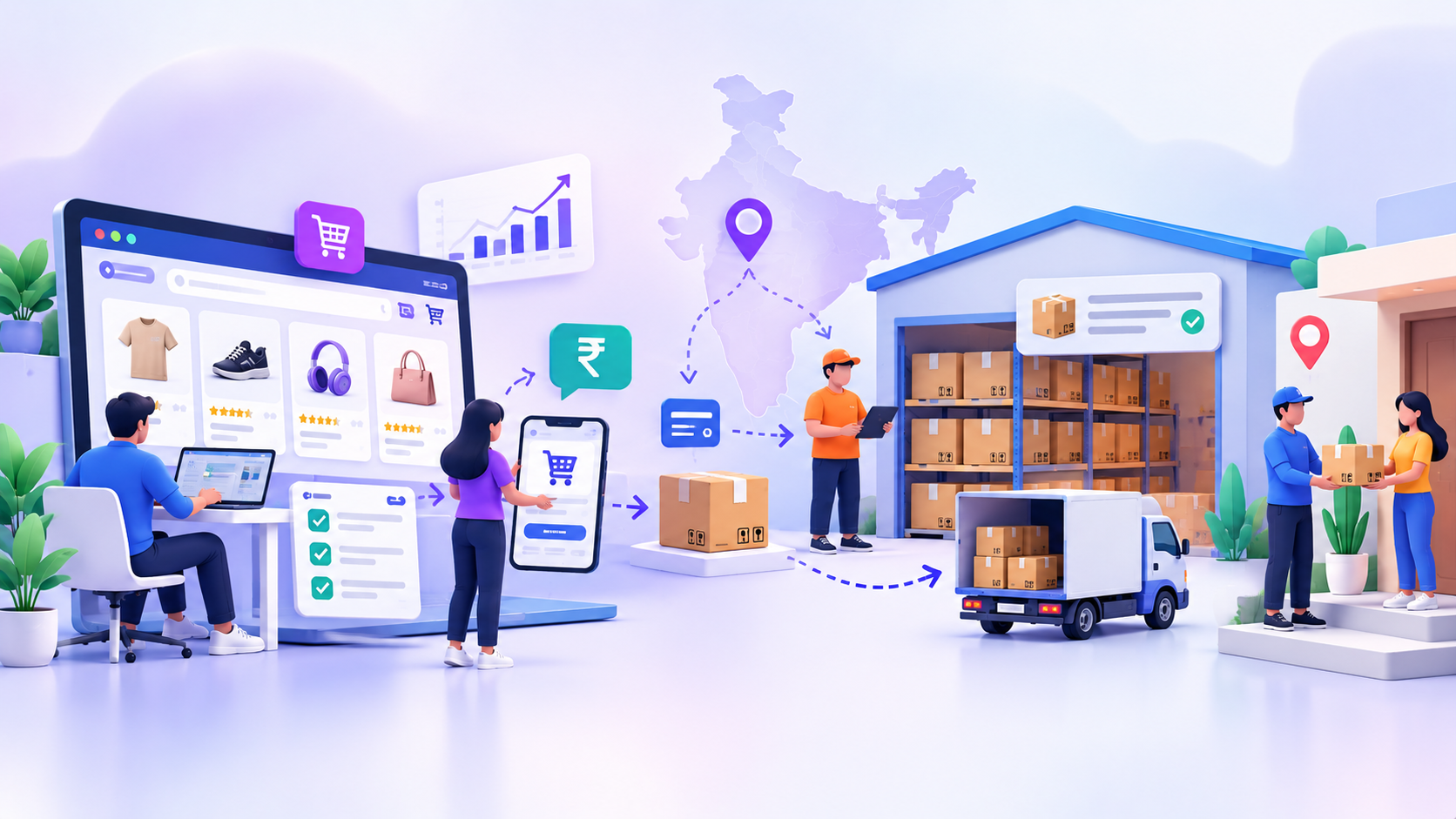
The basic process is straightforward. A customer visits your online store and places an order. You receive the payment and order information, then the supplier prepares and ships the product directly to the customer.
You remain responsible for the customer-facing side of the business, including your website, product presentation, pricing, marketing, customer communication, and overall shopping experience.
The supplier handles inventory and fulfillment according to your agreement.
This makes a dropshipping business in India different from traditional retail, where a seller normally purchases inventory before selling it.
However, you should not confuse lower inventory requirements with a risk-free business. You can still lose money through advertising, refunds, poor product quality, payment processing costs, website expenses, and unreliable suppliers.
How Does Dropshipping Work?
A typical dropshipping business in India follows a simple order flow:
- You select a product and supplier.
- You list the product on your online store.
- A customer places an order.
- You receive the customer’s order and payment.
- You place the fulfillment order with your supplier.
- The supplier packs and ships the product.
- The customer receives the order.
- You provide customer support and handle issues when necessary.
Shopify’s current dropshipping documentation describes a similar process in which the customer orders through the store, the order is sent to the supplier, and the supplier fulfills and ships it directly to the customer.
For a dropshipping business in India, the biggest advantage is that you do not need to purchase large quantities of inventory before knowing whether customers actually want the product.
How Much Money Do You Need to Start?
There is no fixed amount required to start a dropshipping business in India because your costs depend on your store platform, domain, marketing, supplier arrangements, payment gateway, design, and other requirements.
A basic setup may include:
- Domain name
- E-commerce website
- Website hosting or platform subscription
- Store theme or design
- Product research
- Supplier samples
- Payment gateway
- Advertising budget
- Business registration and tax-related costs where applicable
- Packaging or branding requirements, if agreed with the supplier
- Customer support tools
The important point is to separate setup costs from testing capital.
Spending your entire budget on website design leaves little money for product testing and marketing. A simple, professional store with a controlled advertising budget is often a better starting point than an expensive website with no money left to attract customers.
For a low-investment dropshipping business in India, start with a focused product range rather than uploading hundreds of products.
Choose a Specific Niche
One of the first decisions for your dropshipping business in India is choosing a niche.
A niche gives your store a clear direction and makes marketing easier. Instead of trying to sell everything from kitchen accessories to electronics and pet products, focus on a defined customer group or problem.
Potential categories include:
- Home organization
- Pet accessories
- Fitness accessories
- Travel products
- Kitchen tools
- Fashion accessories
- Car accessories
- Desk and workspace products
- Hobby products
- Lifestyle accessories
Do not choose a niche simply because someone calls it “trending.”
Look at demand, competition, product quality, selling price, shipping requirements, return rates, and potential margins.
A strong niche gives you enough products to expand while still keeping your brand recognizable.
Find Products With Real Demand
Product research can determine whether your dropshipping business in India has a realistic chance of generating sales.
Start by looking for products that solve a clear problem, offer convenience, have an understandable benefit, or appeal to a specific audience.
You can research demand through:
- Google Trends
- Search suggestions
- Marketplace listings
- Customer reviews
- Social media discussions
- Competitor stores
- Product research tools
- Industry publications
Do not rely on one viral video or one social media post.
A product that receives attention for a week may not create sustainable demand.
For a dropshipping business in India, products with reasonable selling prices and manageable shipping requirements can be easier to test than bulky, fragile, or extremely expensive products.
Check Product Profitability Before Selling
A product can generate many orders and still lose money.
Before adding anything to your dropshipping business in India, calculate the complete cost of selling it.
For example:
Product selling price: ₹999
Supplier cost: ₹350
Shipping: ₹100
Payment and platform costs: ₹50
Advertising cost per order: ₹250
Estimated amount remaining: ₹249
That ₹249 is not automatically your final profit. You may still have refunds, returns, taxes, customer support expenses, discounts, and other costs.
Your calculation should therefore include the costs that are realistic for your particular business.
Never choose a product simply because the supplier sells it cheaply.
Find Reliable Dropshipping Suppliers in India
A reliable supplier can make or break your dropshipping business in India.
Before working with a supplier, check:
- Product quality
- Actual inventory availability
- Shipping times
- Return process
- Communication speed
- Packaging quality
- Tracking availability
- Pricing consistency
- Replacement policy
- Ability to handle increasing order volume
Always consider ordering samples before listing a product heavily.
A supplier’s product photograph can look excellent while the actual product arrives looking like it survived a small war.
Testing the product yourself gives you a better understanding of quality, packaging, delivery time, and customer experience.
Build a Professional Online Store
Your website is the main sales environment for your dropshipping business in India.
A professional store should have:
- Clear navigation
- Mobile-friendly design
- Fast-loading pages
- High-quality product images
- Useful product descriptions
- Visible pricing
- Shipping information
- Return and refund information
- Secure checkout
- Multiple payment options
- Easy customer support
Do not copy the supplier’s product description word for word.
Write descriptions that explain the product from your customer’s perspective. Explain what it does, who it is for, what problem it solves, and what makes it useful.
Your product page should answer customer questions before they need to contact you.
If you need professional support with your online store, you can explore DigiBrandUp’s E-Commerce and digital services for website development, e-commerce, SEO, digital marketing, and related online business solutions.
Choose the Right E-Commerce Platform
Your platform affects how easily you can manage your dropshipping business in India.
Popular choices include Shopify and WooCommerce.
Shopify provides a hosted e-commerce environment with store management, apps, payment options, and other tools. Its current India offering includes multiple plans designed for different business sizes.
WooCommerce works with WordPress and gives store owners more control over website hosting, themes, plugins, and customization.
The better option depends on your budget, technical requirements, desired customization, and long-term plans.
Do not choose a platform because someone promises it will make your first sales automatically. No platform can compensate for poor products, weak marketing, or an unreliable supplier.
Set Up Payments for Indian Customers
Payment convenience matters when building a dropshipping business in India.
Depending on your target customers and payment provider, you may consider options such as:
- UPI
- Debit and credit cards
- Net banking
- Digital wallets
- Cash on delivery, where appropriate
- Other supported payment methods
Before enabling a payment method, check its current eligibility, fees, settlement terms, refund process, and business requirements.
If you plan to sell through marketplaces, requirements can differ. For example, Amazon India currently states that sellers need seller registration information and tax details, with GST requirements applying to taxable goods under its seller registration process. Check Amazon India’s current seller requirements.
Understand GST and Business Compliance
Before launching a dropshipping business in India, understand the tax and legal requirements that apply to your particular business model.
GST registration, invoicing, product taxes, marketplace rules, consumer protection requirements, payment compliance, and other obligations can vary depending on your business structure, products, location, sales channels, and turnover.
Do not assume that every online seller follows exactly the same requirements.
For a business making regular sales, speak with a qualified tax professional or legal advisor about your specific situation.
You should also provide customers with clear information about pricing, shipping, returns, refunds, contact details, and other applicable policies.
India’s consumer affairs framework includes e-commerce consumer protection guidelines aimed at protecting consumer interests and addressing unfair trade practices.
Create Clear Shipping and Return Policies
Shipping problems can quickly damage a dropshipping business in India.
Before accepting orders, decide:
- Where you will deliver
- Expected delivery times
- Shipping charges
- Tracking availability
- What happens if an order is delayed
- What happens if an item arrives damaged
- How returns are requested
- Who pays return shipping
- How refunds are processed
Do not promise two-day delivery if your supplier normally needs seven days.
Clear expectations reduce customer complaints and make your business look more trustworthy.
Your return policy should also be easy to find rather than hidden somewhere at the bottom of your website.
Start With a Small Product Catalog
A common mistake in a new dropshipping business in India is adding hundreds of products immediately.
More products do not automatically mean more sales.
A smaller catalog allows you to:
- Write better product descriptions
- Create stronger product pages
- Test individual products
- Track performance
- Improve advertising
- Understand customer behavior
- Manage supplier relationships more easily
Start with a small collection that fits the same audience.
Once you identify products that consistently generate interest and profitable orders, you can expand the catalog.
Use SEO to Bring Organic Traffic
SEO can become an important long-term channel for a dropshipping business in India.
Instead of targeting only broad keywords, create content around what potential customers actually search for.
You can target:
- Product-related searches
- Buying guides
- Product comparisons
- How-to searches
- Problem-solving queries
- Product category searches
- Seasonal buying searches
- Frequently asked questions
For example, if your store sells home organization products, you could publish content around small-space storage ideas, kitchen organization, product comparisons, and practical buying guides.
The objective is not to publish hundreds of thin articles. Build useful pages that answer genuine customer questions and connect naturally to relevant products.
Use Social Media to Test Products
Social media can help a dropshipping business in India discover which products attract attention before spending heavily on advertising.
Create short demonstrations, product-use videos, before-and-after examples where appropriate, customer-focused explanations, and lifestyle content.
Do not make every post a sales pitch.
Show the product being used. Explain the problem it solves. Demonstrate its features. Answer common questions.
Good content gives potential customers a reason to stop scrolling.
Use Paid Advertising Carefully
Paid advertising can help a dropshipping business in India reach customers faster, but it can also consume your budget very quickly.
Start with controlled tests.
Instead of spending a large amount on one product immediately, test:
- Different audiences
- Different creatives
- Different product angles
- Different landing pages
- Different offers
Track the numbers that actually matter.
Important metrics include:
- Cost per click
- Conversion rate
- Customer acquisition cost
- Average order value
- Return on ad spend
- Refund rate
- Profit per order
A campaign can have thousands of clicks and still be unprofitable.
Sales volume without healthy margins is not success.
Build Trust Before Asking for the Sale
Trust is especially important for a new dropshipping business in India because customers may not know your brand.
Your store should clearly communicate:
- Who you are
- What you sell
- How orders are shipped
- Expected delivery times
- Return and refund terms
- How customers can contact you
Use genuine reviews when available. Do not manufacture fake testimonials.
If you have product demonstrations, customer photos, or real feedback, use them where appropriate.
A clean website, transparent policies, responsive support, and accurate product information can make a significant difference.
Track Every Order and Expense
Keep proper records from the beginning of your dropshipping business in India.
Track:
- Product cost
- Shipping cost
- Advertising cost
- Payment fees
- Refunds
- Returns
- Discounts
- Revenue
- Profit
- Supplier payments
You need to know whether each product is profitable.
A simple spreadsheet can be enough when you are starting. As order volume increases, consider using accounting and inventory tools appropriate for your business.
Do not wait until you have hundreds of orders to start tracking your numbers.
Common Mistakes to Avoid
Many people start a dropshipping business in India with unrealistic expectations.
Some of the most common mistakes include:
Choosing products without research: A product being popular somewhere else does not guarantee demand from your target customers.
Using unreliable suppliers: Cheap products mean little if customers receive poor-quality items.
Copying supplier descriptions: Generic descriptions make your store look identical to dozens of competitors.
Ignoring mobile users: A large part of online shopping happens through mobile devices, so your store should work properly on smaller screens.
Spending too much on advertising too early: Test campaigns before increasing your budget.
Ignoring customer service: The supplier may ship the product, but the customer still sees you as the seller.
Expecting instant profits: Building a sustainable business takes testing, optimization, and patience.
How to Scale a Dropshipping Business in India
Once your dropshipping business in India has consistent sales, scaling should be based on evidence.
You can consider:
- Adding related products
- Increasing advertising budgets gradually
- Improving product pages
- Negotiating better supplier prices
- Building email marketing campaigns
- Creating stronger SEO content
- Improving customer retention
- Expanding into new regions
- Developing your own brand identity
Do not scale simply because one advertisement produced a few orders.
Look for repeatable performance.
If a product consistently produces profitable sales, customers have acceptable delivery experiences, and your supplier can handle more orders, you have a stronger reason to increase investment.
Is Dropshipping Still Worth Starting in India?
A dropshipping business in India can still be worth exploring if you approach it as a real business rather than a shortcut to quick money.
The model reduces the need for upfront inventory, which can make product testing easier. Shopify’s current guidance also highlights the ability to sell without holding inventory and use supplier fulfillment.
However, competition is real.
Customers can compare products and prices quickly. Advertising costs can change. Suppliers can make mistakes. Delivery delays can damage reviews. Products that work today may become less attractive later.
The businesses that survive are usually the ones that focus on product selection, customer experience, reliable fulfillment, marketing, and continuous improvement.
Frequently Asked Questions
How much money is needed to start a dropshipping business in India?
There is no fixed starting amount. Your budget depends on your website platform, domain, supplier samples, payment setup, marketing, business compliance, and other expenses. Starting with a focused catalog and controlled testing budget can help reduce unnecessary costs.
Is dropshipping legal in India?
Dropshipping itself is an e-commerce fulfillment model, but businesses still need to follow the laws, tax requirements, consumer protection rules, platform policies, and product-specific regulations that apply to their activities. Shopify also advises merchants to comply with the laws applicable to their business and customers.
Is a GST registration required for dropshipping in India?
GST requirements depend on factors such as your business structure, products, turnover, sales channels, and applicable rules. Do not assume that one GST rule applies to every seller. Consult a qualified tax professional for your specific situation.
Can I start dropshipping without keeping inventory?
Yes. The basic dropshipping model allows you to sell products without holding inventory yourself. The supplier generally stores and fulfills the products after receiving the order.
Which products are best for a dropshipping business in India?
There is no universal best product. Look for products with genuine demand, manageable shipping requirements, reasonable margins, reliable suppliers, and a clear customer benefit. Validate demand before investing heavily.
Can I start a dropshipping business with ₹10,000?
A small budget can be used to test a business idea, but ₹10,000 should not be treated as a guaranteed path to profitability. You may need to divide the budget between the store, domain, samples, marketing tests, and unexpected expenses.
How do I find suppliers for dropshipping in India?
You can research manufacturers, wholesalers, supplier directories, trade networks, and specialized dropshipping platforms. Always verify supplier reliability, product quality, pricing, shipping times, and return procedures before committing.
How can I get customers for my dropshipping store?
You can use SEO, social media content, paid advertising, email marketing, influencer partnerships, marketplace channels, and other relevant marketing methods. The best channel depends on your product, audience, budget, and customer behavior.
Can I use Shopify for dropshipping in India?
Yes. Shopify provides tools and integrations that support dropshipping, including supplier connections and product sourcing options. Its current documentation explains several ways merchants can connect with suppliers and fulfill orders.
Can I use WooCommerce for dropshipping?
Yes. WooCommerce can be used for dropshipping through WordPress plugins, supplier integrations, and custom development. It can be useful for businesses that want more control over their website and store functionality.
How profitable is dropshipping in India?
Profitability varies widely. Your results depend on product margins, supplier costs, advertising expenses, payment fees, returns, customer acquisition costs, and conversion rates. There is no guaranteed profit percentage.
Final Thoughts
Starting a dropshipping business in India with low investment is possible, but low investment does not mean no investment and certainly does not mean guaranteed profit.
Start with one clear niche, research products carefully, test suppliers, build a trustworthy store, understand your costs, and focus on customers rather than chasing every trending product.
The goal of a dropshipping business in India should not be to launch as quickly as possible. It should be to build a store that can attract the right customers, fulfill orders reliably, maintain healthy margins, and improve over time.
If you need help creating an online store, product-focused website, SEO strategy, or digital marketing plan, explore DigiBrandUp’s digital services and choose the solution that fits your business stage.
A well-planned dropshipping business in India can become a useful entry point into e-commerce, but the fundamentals still matter: good products, reliable suppliers, clear positioning, strong customer experience, and disciplined marketing.