


WooCommerce vs Shopify: Which Platform Is Best for Your Online Store?
Choosing the right ecommerce platform can shape how easily you launch, manage, market, and grow an online store. Two names that regularly come up are WooCommerce and Shopify. Both can power professional online stores, but they work in very different ways.
The woocommerce vs shopify decision usually comes down to how much control you want, how comfortable you are managing technology, what your budget looks like, and how complex your store may become.
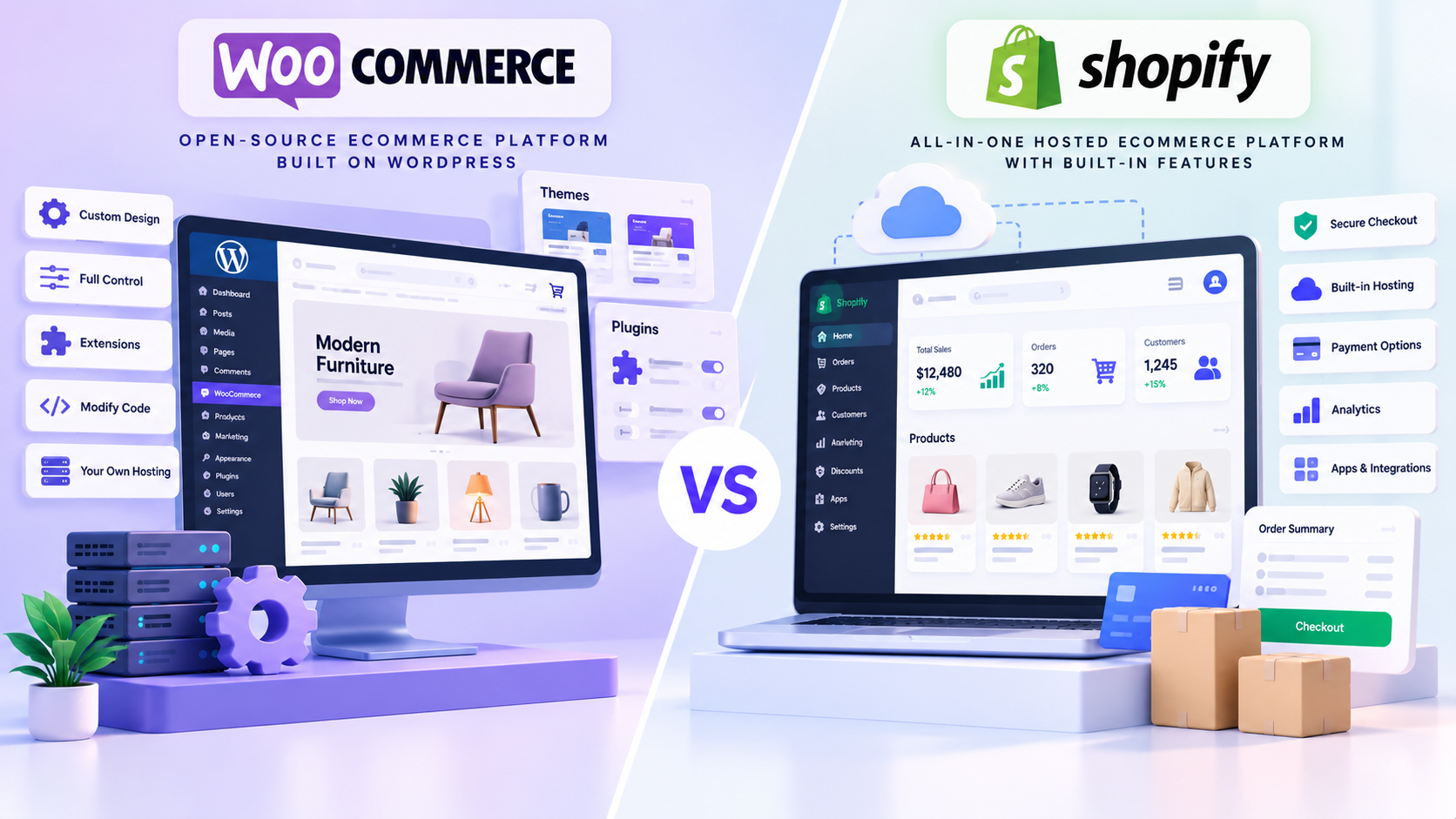
Shopify is a hosted commerce platform that brings hosting, store management, checkout, security, and many ecommerce features together. WooCommerce is an open-source ecommerce platform built for WordPress, giving store owners more control over hosting, customization, extensions, and their website environment.
So, which should you choose?
There is no universal answer. The better platform depends on your business model, technical requirements, budget, growth plans, and the kind of shopping experience you want to create.
WooCommerce vs Shopify: What Is the Main Difference?
The simplest way to understand the woocommerce vs shopify comparison is to look at ownership and management.
Shopify provides a hosted environment. You create your store within Shopify’s platform, choose a plan, select a theme, add products, configure payments and shipping, and manage your business from one dashboard.
WooCommerce works differently. It is a WordPress ecommerce plugin, so you generally need a WordPress website, hosting, a domain, and the WooCommerce software. You then choose themes, extensions, payment gateways, hosting resources, and other components according to your requirements.
This difference affects almost everything else, including setup, maintenance, customization, cost, and technical responsibility.
WooCommerce vs Shopify: Ease of Setup
If getting an online store running quickly is your main concern, the woocommerce vs shopify comparison becomes particularly important.
Shopify is designed around a hosted setup. You do not have to separately purchase hosting or configure a WordPress installation. After creating your account, you can select a theme, add products, configure settings, and start building your storefront.
WooCommerce requires more initial setup because it operates within WordPress. You need hosting and a WordPress installation before configuring WooCommerce. You also have more decisions to make about themes, plugins, backups, security, and performance.
That extra setup is not necessarily a disadvantage. It gives you more control, but it also means there is more to manage.
For a business owner who wants simplicity and prefers not to handle technical infrastructure, Shopify can reduce the amount of setup work.
For someone who already uses WordPress or wants more control over the website environment, WooCommerce can make more sense.
WooCommerce vs Shopify: Pricing and Running Costs
Cost is one of the first things businesses consider when comparing ecommerce platforms.
The woocommerce vs shopify pricing question is slightly misleading if you only compare monthly subscription fees.
Shopify uses a subscription-based model. Its current plans vary by market and billing period, with additional costs potentially depending on payment processing, apps, and other services. Shopify’s India pricing page currently lists Basic, Grow, Advanced, and Plus plans with different monthly costs and features.
WooCommerce itself is free and open source. However, running a WooCommerce store still involves costs such as hosting, domain registration, premium themes, paid extensions, payment processing, security services, and development work when required.
WooCommerce’s official pricing documentation states that the core platform has no monthly subscription and no revenue share, while hosting and extensions can add to the overall cost.
This means the woocommerce vs shopify cost comparison should be based on your complete technology stack rather than the platform fee alone.
A small store may find either option affordable. A highly customized store may spend considerably more on development, integrations, apps, or extensions regardless of the platform.
WooCommerce vs Shopify: Customization
Customization is another major part of the woocommerce vs shopify discussion.
WooCommerce is built on WordPress and uses an open-source approach. Developers can modify themes, add custom functionality, integrate external services, and change many aspects of the store.
This makes WooCommerce particularly attractive when your store needs functionality that goes beyond standard ecommerce features.
Shopify also supports extensive customization through themes, apps, APIs, and development tools. However, the platform operates within Shopify’s ecosystem, so certain technical decisions and limitations are different from those in a self-hosted WordPress environment.
If your store needs a highly specific checkout flow, custom product logic, advanced integrations, or unusual business rules, you should evaluate those requirements before choosing either platform.
The key point in the woocommerce vs shopify debate is not simply which platform has more customization. It is which platform gives your business the type of customization it actually needs.
WooCommerce vs Shopify: SEO
SEO matters because an ecommerce store needs more than attractive product pages. Customers need to be able to discover products through search engines.
When looking at woocommerce vs shopify for SEO, both platforms can support important optimization work.
Shopify includes several SEO features within its platform. Shopify’s official documentation notes that stores can manage elements such as title tags, meta descriptions, URLs, product SEO, collection SEO, image alt text, and other optimization features.
WooCommerce benefits from the broader WordPress ecosystem, where store owners can use SEO plugins, custom content structures, schema tools, internal linking strategies, and other WordPress functionality.
However, the platform itself does not guarantee rankings.
Your results will still depend on keyword research, product and category content, technical SEO, site speed, internal linking, backlinks, search intent, product demand, competition, and overall website quality.
Therefore, the woocommerce vs shopify SEO decision should focus on how effectively you can manage your actual SEO requirements rather than assuming one platform automatically ranks better.
WooCommerce vs Shopify: Design and Themes
Your store’s design influences how customers perceive your brand.
Shopify offers professionally designed themes and a controlled storefront environment. This can make it easier for businesses to create a polished store without building everything from scratch.
WooCommerce gives you access to the large WordPress theme ecosystem. You can choose ecommerce-specific themes or build a custom WordPress design around your store.
In the woocommerce vs shopify design comparison, Shopify can be attractive for businesses that want a streamlined setup, while WooCommerce can be attractive when deeper website customization is important.
Regardless of the platform, avoid choosing a theme simply because it looks impressive in a demo.
Check mobile responsiveness, loading performance, navigation, product-page layout, checkout usability, accessibility, and compatibility with your required plugins or apps.
A beautiful store that takes forever to load is basically an expensive waiting room.
WooCommerce vs Shopify: Security
Security should be considered before launching an online store, not after something goes wrong.
Shopify manages much of the underlying platform infrastructure because it is a hosted solution. This reduces the amount of server-level responsibility for the store owner.
With WooCommerce, security depends more heavily on the website environment. WordPress, plugins, themes, hosting, passwords, backups, and updates all need appropriate management.
This does not mean WooCommerce is inherently insecure. It means responsibility is distributed differently.
In the woocommerce vs shopify comparison, businesses should consider who will manage updates, backups, security monitoring, hosting configuration, and technical maintenance.
If you have a developer or technical team, WooCommerce’s flexibility can be useful. If you prefer a managed platform, Shopify may reduce the technical workload.
WooCommerce vs Shopify: Scalability
Both platforms can support growing ecommerce businesses, but scalability involves more than the number of products you can add.
Traffic, order volume, database performance, hosting resources, integrations, inventory systems, payment processing, logistics, and operational processes all affect scalability.
Shopify manages the hosting infrastructure for you, which can simplify technical scaling.
WooCommerce gives you more control over the hosting environment. You can select infrastructure based on your traffic and performance requirements, but you also need to manage that environment properly.
The woocommerce vs shopify scalability decision should therefore be based on your expected business model rather than the assumption that one platform is suitable only for small stores.
A store selling 100 products with modest traffic has very different requirements from a marketplace-style business with complex integrations and thousands of daily orders.
WooCommerce vs Shopify: Apps, Plugins, and Extensions
Every ecommerce business eventually needs additional functionality.
You might need email marketing, advanced analytics, subscriptions, memberships, shipping integrations, accounting tools, product filters, reviews, CRM integrations, or automation.
Shopify uses apps to extend the functionality of your store.
WooCommerce uses WordPress plugins and WooCommerce extensions.
This makes the woocommerce vs shopify comparison partly a question of ecosystem and management.
Shopify apps can make adding functionality straightforward, but recurring subscription costs can increase your monthly expenses.
WooCommerce extensions can also have one-time or recurring costs, depending on the product and provider.
Before installing anything, check whether the extension is actively maintained, compatible with your platform version, reviewed positively, and actually necessary.
Installing 47 plugins because every one sounded useful is not a business strategy. It is how websites acquire problems as a hobby.
WooCommerce vs Shopify: Payments
Payment options are essential for an online store because customers expect a convenient and trustworthy checkout.
Shopify supports multiple payment options and provides integrated payment capabilities depending on the country and plan.
WooCommerce allows store owners to select payment gateways through extensions and integrations.
For businesses operating in India, payment requirements may include UPI, cards, net banking, wallets, and other local payment methods depending on the target audience and payment provider.
When evaluating woocommerce vs shopify, check the actual payment gateways available in your target market rather than relying only on general platform comparisons.
Also consider transaction fees, payment processing fees, settlement times, refunds, recurring payments, international transactions, and supported currencies.
WooCommerce vs Shopify: Dropshipping
If you are planning a dropshipping business, platform selection becomes even more relevant.
Shopify is widely used with dropshipping applications that help connect stores with product suppliers and fulfillment services.
WooCommerce can also support dropshipping through WordPress plugins and supplier integrations.
The woocommerce vs shopify decision for dropshipping should depend on the supplier tools you intend to use, product catalog size, automation requirements, shipping regions, website customization, and marketing strategy.
Do not choose a platform just because someone on social media claims that it will make dropshipping easy.
The platform is only one part of the business. Product selection, supplier reliability, margins, shipping times, customer service, marketing, and conversion optimization matter just as much.
WooCommerce vs Shopify: Which Is Better for Small Businesses?
For small businesses, the woocommerce vs shopify choice often comes down to simplicity versus control.
Shopify can be attractive when you want a managed environment with fewer technical responsibilities.
WooCommerce can be attractive when you already use WordPress, need extensive customization, or want greater control over hosting and website functionality.
A local clothing brand, for example, may need a straightforward store with product categories, payments, shipping, and social media integration.
A content-heavy brand that wants extensive blogging, custom landing pages, advanced SEO control, and a highly customized website may prefer WordPress with WooCommerce.
The right answer depends on the business rather than the size of the business alone.
WooCommerce vs Shopify: Which Is Better for SEO-Focused Stores?
If organic traffic is a major part of your growth strategy, look closely at your actual SEO workflow.
WooCommerce combined with WordPress can provide extensive content and SEO flexibility. You can build blogs, landing pages, product guides, comparison pages, category content, and other resources within the same website environment.
Shopify also supports SEO optimization and content marketing, and its built-in infrastructure can simplify several technical areas.
In the woocommerce vs shopify SEO comparison, the important question is whether your team can consistently execute good SEO.
Keyword research, content quality, technical health, internal linking, product optimization, structured data, and digital PR can matter more than the platform choice itself.
WooCommerce vs Shopify: Which Platform Is Easier to Manage?
Management is where the woocommerce vs shopify difference becomes very practical.
Shopify centralizes much of the store management process. Hosting, platform updates, and many infrastructure-related responsibilities are handled by Shopify.
WooCommerce requires more active management because it runs within WordPress and depends on your hosting environment and installed extensions.
That extra responsibility can be worthwhile when your business needs flexibility.
But if you do not have anyone responsible for updates, backups, security, and technical maintenance, you should factor that into your decision.
WooCommerce vs Shopify: A Quick Comparison
| Feature | WooCommerce | Shopify |
|---|---|---|
| Platform model | Open-source WordPress ecommerce | Hosted ecommerce platform |
| Core platform cost | Free | Subscription-based |
| Hosting | Chosen separately | Included |
| Customization | Highly flexible | Flexible within Shopify ecosystem |
| Technical management | More responsibility | More managed |
| SEO | Strong WordPress ecosystem | Built-in SEO features |
| Themes | Large WordPress ecosystem | Shopify theme ecosystem |
| Extensions | Plugins and extensions | Apps |
| Best suited for | Custom stores and WordPress users | Managed ecommerce stores |
| Scalability | Depends heavily on hosting and setup | Managed platform infrastructure |
| Maintenance | More hands-on | Generally simpler |
The comparison shows why there is no universal winner in the woocommerce vs shopify discussion.
WooCommerce vs Shopify: Which One Should You Choose?
Choose Shopify if your priority is a managed ecommerce environment, faster setup, centralized store management, and reduced responsibility for hosting infrastructure.
Choose WooCommerce if your priority is greater control over your website, extensive customization, WordPress integration, flexible hosting, and access to the broader WordPress ecosystem.
If you are still unsure, start by listing your actual business requirements.
Ask yourself:
- How many products will I sell?
- Which payment gateways do I need?
- Which countries will I sell to?
- Do I need a blog-heavy website?
- Will I need custom functionality?
- Who will maintain the website?
- What is my monthly technology budget?
- Which marketing channels will I use?
- Do I need advanced integrations?
- How important is customization?
Once you answer these questions, the woocommerce vs shopify decision becomes much easier.
How DigiBrandUp Can Help With Your E-Commerce Store
Choosing a platform is only the first step.
Your online store also needs a strong structure, responsive design, product pages, payment integration, SEO, conversion-focused navigation, analytics, and a marketing strategy.
DigiBrandUp provides E-Commerce Services for businesses that want to build and grow their online stores. The right platform can then be selected according to your products, audience, budget, technical requirements, and growth plans.
If you need a customized online store, professional Web Development Services can also help create a website around your specific business requirements.
Frequently Asked Questions
Is WooCommerce better than Shopify?
The woocommerce vs shopify decision depends on your requirements. WooCommerce offers strong customization and control through WordPress, while Shopify provides a more managed ecommerce environment.
Is Shopify easier than WooCommerce?
For many beginners, Shopify can be easier to set up because hosting and much of the platform infrastructure are managed for you. WooCommerce requires more initial configuration but offers greater control over the website environment.
Which is cheaper, WooCommerce or Shopify?
The answer depends on your complete setup. WooCommerce itself is free, but hosting, extensions, themes, development, and maintenance can add costs. Shopify uses subscription plans and may also involve app and payment-related costs.
Which is better for SEO, WooCommerce or Shopify?
Both can support SEO. WooCommerce benefits from WordPress’s content and plugin ecosystem, while Shopify includes several built-in SEO capabilities. Your SEO execution, content, technical optimization, and search intent strategy remain more important than simply selecting one platform.
Can WooCommerce handle a large online store?
Yes. WooCommerce can support large stores when the hosting environment, database, caching, code, extensions, and overall architecture are properly configured.
Can Shopify handle a growing business?
Yes. Shopify provides multiple plans and higher-tier options designed for businesses with different operational and sales requirements. The appropriate plan depends on factors such as sales volume, staff requirements, international selling, and required features.
Can I migrate from WooCommerce to Shopify?
Yes, migration is possible, but it should be planned carefully. Product data, customer records, URLs, orders, SEO metadata, redirects, images, payment settings, and integrations may all need attention.
Can I migrate from Shopify to WooCommerce?
Yes. A Shopify store can be migrated to WooCommerce, but the process requires careful planning to preserve important data, URLs, SEO value, customer information, and store functionality.
Which platform is better for dropshipping?
Both can support dropshipping. The right choice depends on your supplier integrations, automation requirements, product catalog, customization needs, shipping regions, and overall business strategy.
Final Thoughts
There is no single platform that is perfect for every online store.
The woocommerce vs shopify decision should be based on your business goals, technical requirements, budget, marketing strategy, and long-term plans. Before choosing a platform, it is also worth reviewing the official platform information from WooCommerce and Shopify to understand their available features and ecosystem.
Shopify can make sense when you want a managed platform and a simpler operational setup. WooCommerce can make sense when you want WordPress integration, greater control, and extensive customization.
Before making a decision, think beyond the initial website launch. Consider how you will manage products, SEO, marketing, payments, customer experience, security, integrations, analytics, and future growth.
The best ecommerce platform is ultimately the one that fits the way your business actually operates.
For businesses that need help planning, designing, developing, and optimizing an online store, DigiBrandUp’s E-Commerce Services can help turn the platform decision into a practical ecommerce setup.