

7 Essential Features of a Good Business Website
A business website is more than an online brochure. It is often the first place where potential customers learn about your company, compare your services, and decide whether they can trust your brand.
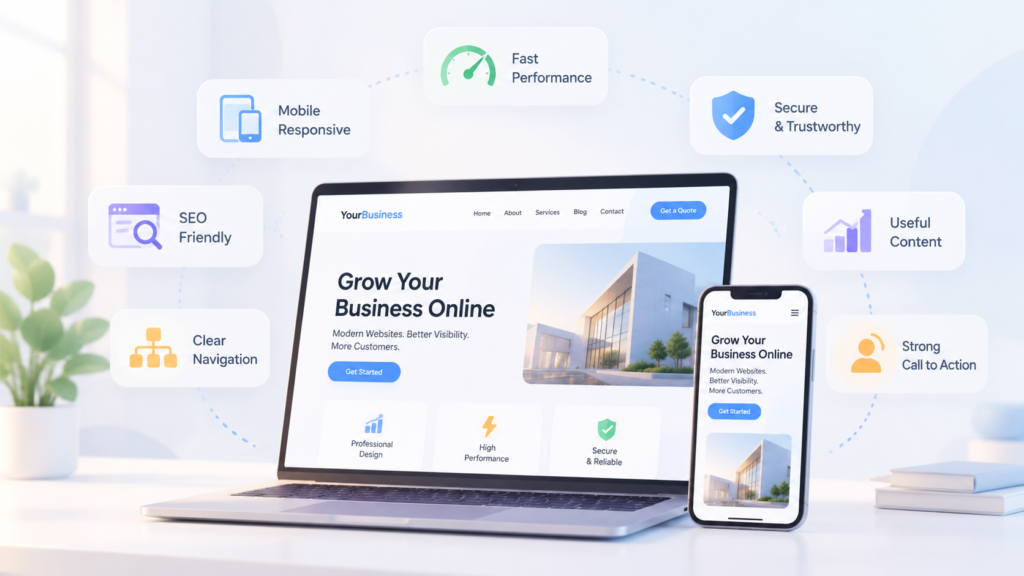
A good business website should look professional, load efficiently, work across different devices, make information easy to find, and guide visitors toward a useful action such as contacting your business, requesting a quote, or making a purchase.
If your website looks attractive but is slow, confusing, difficult to use on mobile, or impossible to find through search, the design alone will not do much for your business. Here are seven essential features every modern business website should have.
1. Responsive and Mobile-Friendly Design
A business website should work properly on desktops, laptops, tablets, and smartphones.
Mobile responsiveness means that the website layout, images, buttons, menus, and content automatically adapt to different screen sizes. Visitors should not have to zoom in, scroll sideways, or struggle to click small buttons.
Mobile-friendly design is also important for search visibility and user experience. Google recommends that website owners pay attention to how their content displays on mobile devices as part of overall page experience.
A responsive website should provide:
- Easy-to-read text
- Flexible images
- Simple mobile navigation
- Clearly visible buttons
- Properly sized forms
- Fast loading on mobile connections
For businesses, this matters because a visitor who cannot comfortably use your website may simply leave and look for another company.
2. Fast Website Performance
Website speed directly affects how people experience your business online.
If a page takes too long to load, visitors may leave before they even see your services. Slow websites can also make your brand appear less professional, particularly when customers are comparing several businesses.
Google recommends paying attention to Core Web Vitals as part of creating a good page experience. However, Google also makes clear that achieving perfect performance scores does not automatically guarantee higher search rankings.
A fast business website should use:
- Optimized images
- Efficient code
- Reliable hosting
- Browser caching
- Limited unnecessary scripts
- Properly configured plugins
- Optimized fonts and media
Performance should be treated as both a user-experience and business consideration, rather than simply chasing a perfect Lighthouse score.
3. Clear Navigation and Website Structure
Visitors should be able to understand your website without having to solve a puzzle.
A clear navigation system helps users quickly find important pages such as:
- Home
- About
- Services
- Products
- Blog
- Contact
Your most important services should also be easy to discover.
For example, a digital business offering web development, e-commerce, SEO, dropshipping, and digital marketing should organize these services clearly instead of placing everything on one overcrowded page.
A logical website structure also helps search engines understand the relationship between your pages. Internal links can connect informative blog content with relevant service pages, creating a clearer topical structure.
4. SEO-Friendly Website Structure
A visually impressive website is not automatically an SEO-friendly website.
Search engine optimization should be considered during website development rather than added as an afterthought.
Important SEO elements include:
- Descriptive page titles
- Useful meta descriptions
- Logical heading structure
- SEO-friendly URLs
- Descriptive image alt text
- Internal linking
- Mobile-friendly pages
- Crawlable content
- Proper redirects
- Secure HTTPS implementation
Google recommends creating helpful, reliable, people-first content rather than producing content primarily to manipulate search rankings. Read Google’s official guidance on helpful content
This means your website should first make sense to customers and then be structured so search engines can understand it.
A strong website development process should therefore consider SEO from the beginning.
5. Strong Calls to Action
Your website should tell visitors what they can do next.
A call to action, commonly called a CTA, guides users toward a specific step. Examples include:
- Get a Quote
- Contact Us
- Book a Consultation
- Start Your Project
- Request a Demo
- Shop Now
The CTA should match the visitor’s intent.
For example, someone reading about website development may be more interested in a consultation or project quote than a generic “Learn More” button.
Calls to action should be visible without becoming aggressive. Every page does not need five flashing buttons screaming for attention. Humans have enough problems already.
6. Secure and Trustworthy Website
Visitors need confidence before sharing their personal information or doing business with you.
Your website should use HTTPS and follow basic security practices. Forms should be handled securely, software should be updated, and unnecessary plugins or scripts should be avoided.
Trust can also be strengthened through genuine business information such as:
- Clear contact details
- Company information
- Service descriptions
- Customer testimonials
- Case studies
- Business policies
- Professional branding
A trustworthy website does not need to make exaggerated claims. Clear information, consistent branding, transparent communication, and a professional user experience usually do more for credibility.
7. Useful Content That Answers Customer Questions
A business website should answer the questions customers actually have.
Your service pages can explain what you offer, while your blog can address informational questions people search before contacting a business.
For example, a web development company could publish articles about:
- How much does website development cost?
- What should a business website include?
- WordPress vs custom website development
- How to make a website mobile-friendly
- How does website speed affect user experience?
- What is an SEO-friendly website?
This creates a connection between informational search intent and commercial intent.
Someone searching for “what should a business website include?” may not be ready to hire a developer immediately. But after reading a useful article, that visitor may realize that their current website has several problems and begin researching professional website development services.
Google’s guidance emphasizes content that is genuinely useful to an intended audience rather than content produced simply to attract search traffic.
Why These Website Features Matter for SEO
SEO is not just about inserting keywords into pages.
Search engines need to understand your content, while users need to understand your business. These goals often overlap.
A well-structured business website can make important information easier to discover, improve navigation, support internal linking, and provide a better experience across devices.
Google also notes that page experience involves multiple aspects rather than one single ranking signal. Core Web Vitals, secure delivery, mobile usability, and avoiding intrusive elements are among the areas website owners should consider.
For that reason, website development and SEO should not be treated as completely separate activities.
How DigiBrandUp Can Help
Building a business website involves more than selecting a template and publishing a few pages.
DigiBrandUp provides Web Development Services focused on creating modern, responsive, and high-performing websites aligned with business goals.
The development process can also be connected with other digital requirements such as SEO, e-commerce, and digital marketing, depending on the business model.
A website should ultimately help your business communicate its value, attract relevant visitors, and make it easier for potential customers to take the next step.
You can explore DigiBrandUp’s Web Development Services and other Digital Services to understand how these solutions can support an online business.
Frequently Asked Questions
What makes a good business website?
A good business website should be responsive, fast, secure, easy to navigate, SEO-friendly, and focused on helping visitors understand the business and take the next step.
Why is responsive web design important?
Responsive web design allows a website to adapt to different screen sizes, including smartphones, tablets, laptops, and desktop computers. This improves usability and creates a more consistent experience across devices.
Does website speed affect SEO?
Website performance is one part of Google’s overall page experience considerations, and Core Web Vitals are used by Google’s ranking systems. However, good performance alone does not guarantee high search rankings.
How can a website generate more leads?
A website can support lead generation by clearly explaining services, addressing customer questions, using visible calls to action, providing easy-to-use contact forms, and building trust through useful information and genuine proof.
Should SEO be included during website development?
Yes. Considering SEO during development can help create a stronger site structure, cleaner URLs, better navigation, optimized content, and a foundation that is easier for search engines to understand.
What should a small business website include?
At minimum, a small business website should clearly explain what the business does, who it serves, what it offers, how customers can contact it, and why customers should trust it. Important pages commonly include Home, About, Services or Products, Blog, and Contact.
Final Thoughts
A good business website should work as a business tool, not simply as an online poster.
Responsive design, performance, clear navigation, SEO-friendly structure, strong calls to action, security, and useful content all contribute to a website that is easier for people to use and easier for search engines to understand.
If your current website is difficult to navigate, slow on mobile, unclear about your services, or not generating meaningful enquiries, redesigning the visual appearance alone may not solve the underlying problem.
The better approach is to evaluate the complete website experience and improve the areas that affect users, search visibility, and business goals.